What Is a Letter of Intent (LOI)? Meaning, Binding vs. Non-Binding, and Template

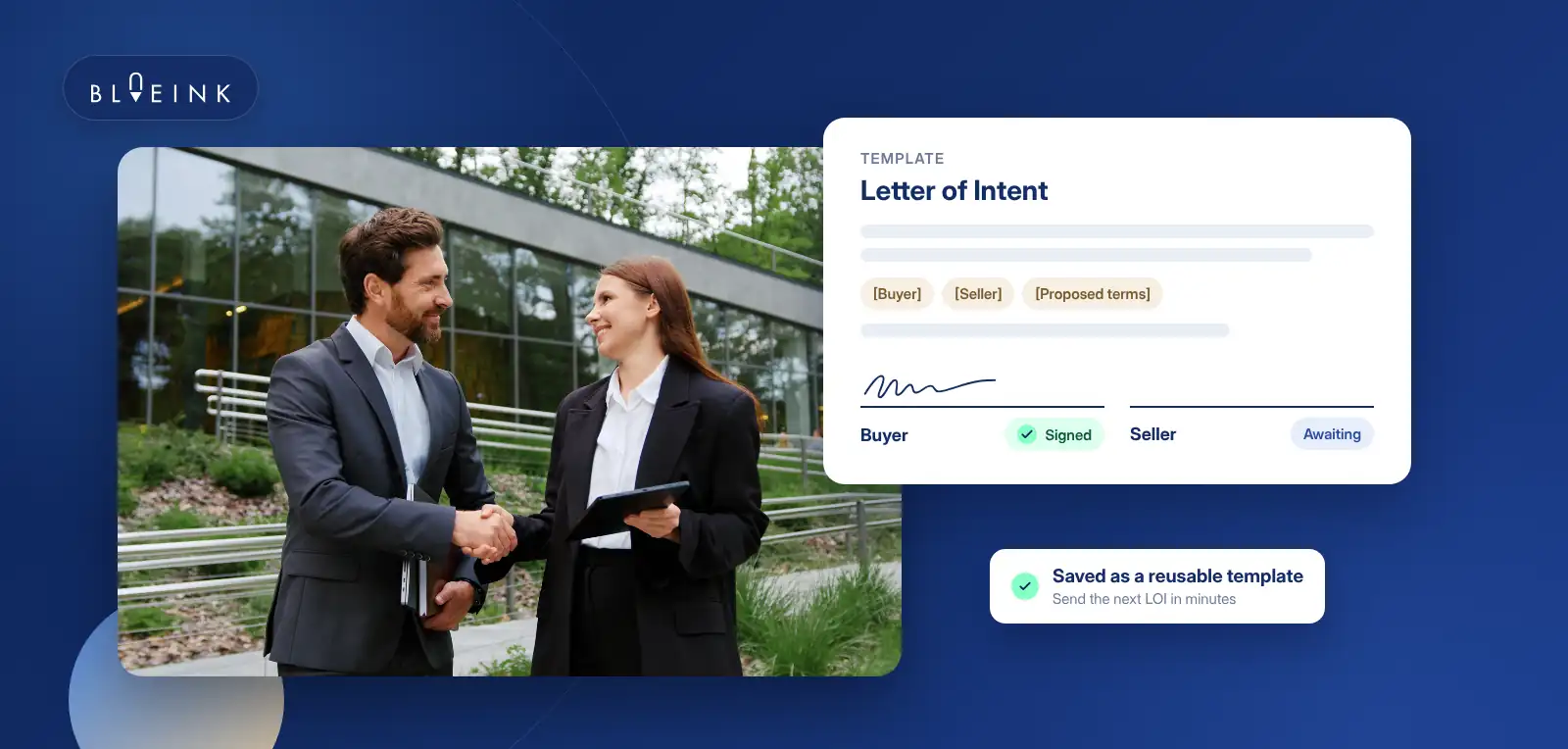
A letter of intent (LOI) is a preliminary document that outlines the main terms of a proposed business transaction before the parties negotiate or sign a final agreement. Businesses commonly use LOIs for acquisitions, purchases, partnerships, joint ventures, and real estate deals. Some provisions may be binding even when the overall transaction remains non-binding.
What Is a Letter of Intent?
A letter of intent records the parties' current understanding of a proposed deal before they complete the final contract. An LOI can help answer basic questions early in negotiations:
- Who are the parties?
- What transaction are they considering?
- What are the proposed financial terms?
- What needs to happen before the deal closes?
- Which issues still need to be negotiated?
- Are any provisions intended to be binding now?
- How long will the parties negotiate before the LOI expires?
For example, a buyer considering the acquisition of a small business might use an LOI to outline the proposed purchase price, transaction structure, due diligence period, exclusivity period, and target closing date.
The parties can then use those agreed starting points to negotiate the detailed purchase agreement.
An LOI is therefore usually not a substitute for the final contract. Its purpose is to document where negotiations stand and give the parties a framework for moving forward. Some businesses use a similar preliminary document called a memorandum of understanding.
Letters of intent can also refer to letters used in employment or academic applications, but this guide focuses only on business LOIs used in commercial transactions.
When Businesses Use a Letter of Intent
Businesses often use LOIs when a transaction is important or complex enough that the parties want to agree on major points before investing more time and money in final documentation.
Common examples include:
- buying or selling a business
- purchasing commercial property
- negotiating a merger or acquisition
- forming a strategic partnership
- creating a joint venture
- negotiating an investment
- purchasing significant assets
- entering a major commercial relationship
The LOI gives the parties a place to record the major commercial terms while leaving room for due diligence, approvals, financing, and final contract negotiations.
Letter of Intent to Purchase a Business or Property
A letter of intent to purchase outlines the proposed terms under which a buyer may acquire a business, property, or other asset.
For a business acquisition, the LOI might include:
- proposed purchase price
- whether the transaction is an asset or equity purchase
- payment structure
- due diligence period
- financing conditions
- exclusivity
- confidentiality
- target closing date
- conditions that must be satisfied before closing
In a real estate transaction, the parties might instead address the property, proposed price, deposits, inspections, financing, due diligence, closing timeline, and other material terms.
An LOI does not eliminate the need for the final purchase agreement. Instead, it helps the parties decide whether they have enough common ground to continue negotiating.
Blueink's real estate transaction workflows provide one example of how documents can move between parties electronically once they are ready for signature.
Partnerships and Joint Ventures
Businesses may also use a letter of intent before forming a partnership, strategic alliance, or joint venture. The LOI can summarize the proposed relationship before the parties draft more detailed agreements.
For example, it might identify:
- each party's proposed role
- financial contributions
- resources or intellectual property each party expects to provide
- ownership or revenue-sharing concepts
- responsibilities during the negotiation period
- target dates
- confidentiality obligations
- next steps toward definitive agreements
A detailed partnership or joint venture agreement will usually require far more information. The LOI helps the parties determine whether the basic commercial structure is workable before they negotiate those details.
Is a Letter of Intent Legally Binding?
A letter of intent is not automatically binding or non-binding simply because it is called an LOI.
Whether particular provisions create enforceable obligations can depend on the document's language, the parties' expressed intent, the terms that remain unresolved, the surrounding circumstances, and the law that applies.
For example, in Burbach Broadcasting Co. v. Elkins Radio Corp., the U.S. Court of Appeals for the Fourth Circuit considered a signed letter of intent for the purchase of radio-station assets. The court explained that when intent is unclear from the document itself, whether the parties intended to be bound can depend on the facts and circumstances of the transaction.
That decision illustrates why businesses should not rely on the heading "Letter of Intent" to determine legal effect. The language inside the document matters.
Binding vs. Non-Binding Provisions
A business LOI can contain both non-binding deal terms and provisions that the parties intend to be binding.
A simplified structure might look like this:
| Provision | Common Treatment in an LOI |
|---|---|
| Proposed purchase price | Often stated as non-binding |
| Transaction structure | Often non-binding |
| Target closing date | Often non-binding |
| Due diligence terms | Depends on drafting and applicable law |
| Confidentiality | May be expressly binding |
| Exclusivity / no-shop | May be expressly binding |
| Expenses | May be expressly binding |
| Governing law | May apply to binding provisions |
| Final obligation to close | Often reserved for the definitive agreement |
This table is illustrative only. It does not determine whether a particular provision will be enforceable.
A non-binding LOI might expressly state that the proposed transaction terms are for discussion only and that neither party is obligated to complete the transaction until a final agreement has been negotiated, approved, and signed.
At the same time, the parties might state that specific sections, such as confidentiality or exclusivity, are intended to take effect immediately.
The legal effect of these provisions depends on the document's wording, the parties' intentions, the circumstances, and applicable law.
The safest approach is to have counsel draft or review the binding and non-binding language for the specific deal and jurisdiction.
What to Include in a Letter of Intent
The exact contents depend on the transaction, but a business letter of intent commonly addresses the following.
1. Parties
Identify the legal names of the businesses, individuals, or entities involved.
2. Purpose of the LOI
Explain the transaction the parties are considering.
For example:
The parties are discussing the proposed acquisition by Buyer of substantially all of the assets of Seller.
3. Proposed Transaction Terms
Set out the commercial terms that have been discussed so far.
Depending on the deal, these may include price, payment structure, assets involved, ownership percentages, financing, or other financial terms.
4. Due Diligence
Describe whether one party will have an opportunity to review financial statements, contracts, records, property information, intellectual property, or other materials before moving forward.
5. Conditions
Identify major conditions that would need to occur before a final transaction.
Examples could include financing, board approval, regulatory approval, satisfactory due diligence, or negotiation of the definitive agreement.
6. Timeline
Include important dates such as the due diligence period, negotiation deadline, expected execution date, or proposed closing date.
7. Confidentiality
State how confidential information exchanged during negotiations will be handled.
If the parties already have a separate nondisclosure agreement, the LOI can refer to it rather than duplicating conflicting confidentiality provisions.
8. Exclusivity
If applicable, explain whether either party agrees not to negotiate with competing buyers or counterparties for a specified period.
Because exclusivity can create meaningful legal obligations, have counsel review the language before including it.
9. Expenses
Explain whether each party pays its own legal, accounting, diligence, and transaction costs or whether another arrangement applies.
10. Binding and Non-Binding Provisions
Identify clearly which sections, if any, are intended to be legally binding.
11. Governing Law
If appropriate, identify the law that applies to any binding provisions.
12. Expiration
State when the LOI expires if it has not been accepted.
13. Signatures
Provide signature blocks for the parties or their authorized representatives.
Free Letter of Intent Template
The following letter of intent template is a starting point for a business transaction. It is not designed for every deal or jurisdiction.
Have qualified legal counsel review and customize it before use.
LETTER OF INTENT
Date: [Date]
To: [Recipient Legal Name]
[Recipient Address]
From: [Sender Legal Name]
[Sender Address]
Re: Proposed [Purchase / Acquisition / Partnership / Transaction]
Dear [Name],
This letter of intent ("LOI") summarizes the principal terms currently being discussed between [Party A] and [Party B] regarding the proposed [describe transaction].
1. Proposed Transaction
[Describe the proposed purchase, acquisition, investment, partnership, real estate transaction, or other business arrangement.]
2. Proposed Financial Terms
The proposed consideration is [purchase price / investment amount / financial terms], payable as follows: [payment structure].
3. Due Diligence
Following acceptance of this LOI, [Party] will have until [date / number of days] to conduct due diligence concerning [business / assets / property / transaction], subject to any agreed confidentiality obligations.
4. Conditions
The proposed transaction is subject to conditions including [satisfactory due diligence / financing / internal approvals / negotiation and execution of definitive agreements / other conditions].
5. Target Timeline
The parties currently anticipate negotiating definitive agreements by [date] and, if those agreements are completed and all conditions are satisfied, closing the proposed transaction on or around [date].
6. Confidentiality
[Insert confidentiality terms or reference an existing confidentiality agreement.]
7. Exclusivity
[Optional: Insert any exclusivity or no-shop provision, including its duration.]
8. Expenses
[Each party will bear its own expenses / insert other arrangement.]
9. Binding Effect
Except for Sections [identify any provisions intended to be binding], this LOI is intended only to summarize the parties' current intentions and does not obligate either party to complete the proposed transaction. No obligation to complete the transaction will arise unless and until the parties execute a definitive agreement, subject to the terms of that agreement.
[IMPORTANT: This sample language does not determine whether an LOI or any provision will be enforceable. Have counsel customize this section for the transaction and applicable law.]
10. Governing Law
Any provisions of this LOI that are intended to be binding will be governed by the laws of [Jurisdiction], without regard to conflict-of-law principles, if appropriate and as advised by counsel.
11. Expiration
This LOI will expire at [time] on [date] unless signed by both parties before that time or extended in writing.
If these terms reflect your current understanding of the proposed transaction, please indicate acceptance below.
Sincerely,
[PARTY A LEGAL NAME]
By: ______________________________
Name: ______________________________
Title: ______________________________
Date: ______________________________
ACKNOWLEDGED AND AGREED:
[PARTY B LEGAL NAME]
By: ______________________________
Name: ______________________________
Title: ______________________________
Date: ______________________________
This template is provided for general informational purposes only and is not legal advice. Whether an LOI or any provision is binding depends on the drafting, circumstances, transaction, and applicable law. Have qualified counsel review the document before sending or signing it.
What to Customize Before You Send It
Do not treat the template as a fill-in-the-blanks shortcut for every transaction. Before sending the LOI, review at least these areas:
- the exact legal names of each party
- the transaction being proposed
- purchase price or other financial terms
- what is included or excluded from the transaction
- due diligence scope and deadline
- financing or approval conditions
- proposed closing date
- confidentiality terms
- any exclusivity period
- expense allocation
- which provisions are intended to be binding
- governing law
- expiration date
- the authorized signatories for each party
The binding effect language deserves particular attention. Writing "non-binding" at the top does not necessarily resolve the legal effect of every provision. The document should clearly identify the obligations the parties intend to create now and those they intend to leave for the final agreement.
From LOI to Final Contract
Signing an LOI is usually an intermediate step, not the end of the transaction. What happens next depends on the deal, but the process commonly includes:
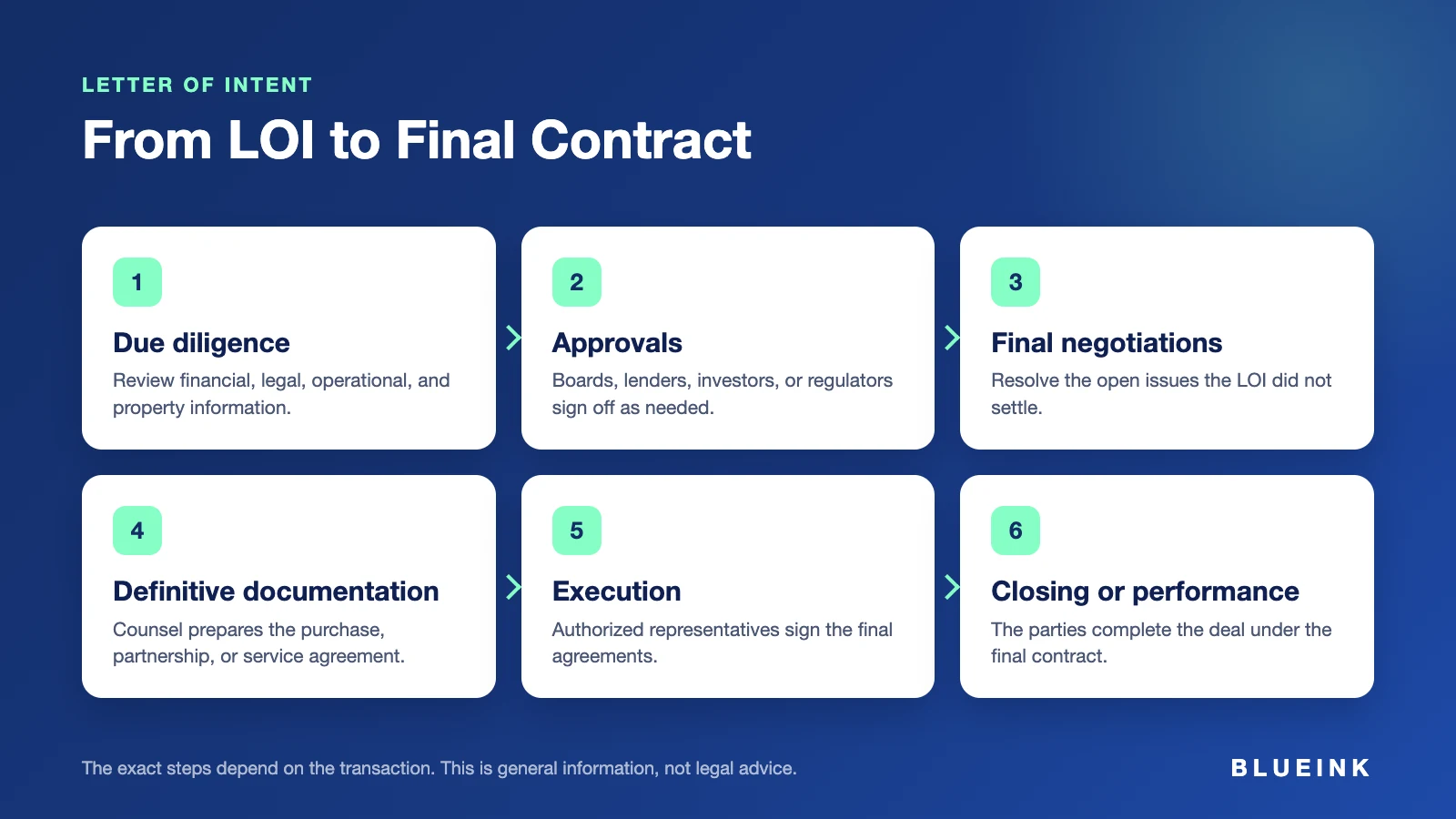
- Due diligence. The parties review financial, legal, operational, property, or other relevant information.
- Approvals. Management, boards, lenders, investors, regulators, or other stakeholders may need to approve the transaction.
- Final negotiations. The parties resolve open issues that were not settled in the LOI.
- Definitive documentation. Counsel prepares the purchase agreement, partnership agreement, master service agreement, or another final contract appropriate to the transaction.
- Execution. Authorized representatives sign the final agreements.
- Closing or performance. The parties complete the transaction according to the definitive contract.
An LOI may therefore lead to a much more detailed agreement containing representations, warranties, covenants, indemnification, termination provisions, remedies, and other terms not addressed in the preliminary document.
Blueink's guide to types of contracts provides more context on the different agreements businesses may use.
Once all required signatures and other execution requirements for a final agreement have been completed, it may become an executed contract, depending on its terms and applicable requirements.
How to Sign a Letter of Intent Online With Blueink
Once counsel and the parties have approved the LOI, Blueink can move the signing process online.

1. Upload the Approved LOI
Prepare the final LOI outside Blueink, then upload the document to create an envelope or reusable template.
If your business regularly sends similar LOIs, you can turn the approved document into a reusable Blueink template rather than setting up the document again for each transaction. Blueink templates let you assign signer roles and preset fields for repeated use.
2. Add the Signers
Assign signer roles such as Buyer, Seller, Company Representative, or another label that fits the transaction. Blueink signer roles help identify the responsibilities of different participants when templates involve multiple signers.
3. Add Signature and Date Fields
Place the required signature, date, text, or other fields for each signer. Make sure each field is assigned to the correct person before sending.
4. Set the Signing Order if Needed
Some LOIs can go to both parties at the same time. Others may need one party to sign before the document moves to the other.
Blueink supports signing order for envelopes with multiple signers. When signing order is enabled, the envelope moves to the next designated signer after the prior signer completes their part.
Learn more about how to set signing order in Blueink.
5. Send the LOI for Signature
Review the signer information, fields, and document, then send the envelope. The parties can review and sign the LOI electronically rather than printing, scanning, or mailing copies.
6. Keep the Completed Signing Record
After completion, Blueink provides a Certificate of Evidence for the signing transaction. The certificate acts as an event record for the completed envelope and can include signer and authentication information.
Explore Blueink contract signing workflows for more ways to manage business agreements electronically.
Ready to send your approved LOI electronically? Start your free Blueink trial and manage the signing process online.
Already have an LOI your business uses repeatedly? Turn it into a reusable Blueink template with signer roles and preset fields so you can prepare future transactions without rebuilding the document each time.
Learn more about building an eSignature template library.
Frequently Asked Questions
What Is a Letter of Intent?
A letter of intent, or LOI, is a preliminary document that outlines the main terms of a proposed transaction before the parties complete a final agreement.
Businesses commonly use LOIs for acquisitions, purchases, real estate deals, investments, partnerships, and joint ventures.
What Does LOI Mean in Business?
LOI stands for letter of intent.
In business, it usually describes a document that records the parties' current understanding of a proposed deal and establishes a framework for further negotiation, due diligence, approvals, and final documentation.
Is a Letter of Intent Legally Binding?
It depends. Some LOIs are drafted primarily as non-binding statements of proposed deal terms. Others include provisions that the parties expressly intend to be binding, such as confidentiality or exclusivity.
The title "letter of intent" does not by itself determine enforceability. Courts may consider the document's wording, the parties' expressed intent, and other circumstances under applicable law.
Have counsel review the LOI before relying on a provision as binding or non-binding.
What Should a Letter of Intent Include?
A business LOI commonly identifies the parties, proposed transaction, financial terms, due diligence process, conditions, timeline, confidentiality terms, exclusivity if applicable, expenses, binding and non-binding provisions, governing law, expiration date, and signatures. The exact provisions depend on the transaction.
What Happens After a Letter of Intent Is Signed?
The parties typically move into the next stage of the transaction, which may include due diligence, financing, internal approvals, additional negotiations, and preparation of the final contract. Signing an LOI does not necessarily mean the underlying transaction is complete.
Can a Letter of Intent Be Signed Electronically?
Yes, many business LOIs can be signed electronically.
For transactions within the scope of the federal ESIGN Act, a signature, contract, or other record generally cannot be denied legal effect solely because it is electronic. The Act does not remove other legal requirements that may apply to the transaction.
Whether the terms of the LOI itself are enforceable is a separate question from whether the parties used electronic signatures.
Is a Letter of Intent the Same as a Contract?
Not necessarily. A letter of intent is usually a preliminary document used before the parties enter a definitive contract. Depending on its wording and applicable law, however, an LOI may contain provisions that create binding obligations.
Businesses should therefore avoid assuming that an LOI has no legal effect simply because a final contract has not yet been signed.
Disclaimer
Blueink is not a law firm and does not provide legal advice. This page is for informational purposes only and should not be considered a substitute for professional legal counsel. If you have questions about the validity or enforceability of eSignatures or digital signatures, we recommend consulting with a licensed attorney. Use of Blueink’s services is subject to our Terms of Use and Privacy Policy.

Weekly Newsletter
Get the latest updates, tips, and exclusive offers. Sign up for our weekly newsletter and stay informed!
Recent post
October 16, 2026
October 12, 2026
A letter of intent (LOI) is a preliminary document that outlines the main terms of a proposed business transaction before the parties negotiate or sign a final agreement. Businesses commonly use LOIs for acquisitions, purchases, partnerships, joint ventures, and real estate deals. Some provisions may be binding even when the overall transaction remains non-binding.
What Is a Letter of Intent?
A letter of intent records the parties' current understanding of a proposed deal before they complete the final contract. An LOI can help answer basic questions early in negotiations:
- Who are the parties?
- What transaction are they considering?
- What are the proposed financial terms?
- What needs to happen before the deal closes?
- Which issues still need to be negotiated?
- Are any provisions intended to be binding now?
- How long will the parties negotiate before the LOI expires?
For example, a buyer considering the acquisition of a small business might use an LOI to outline the proposed purchase price, transaction structure, due diligence period, exclusivity period, and target closing date.
The parties can then use those agreed starting points to negotiate the detailed purchase agreement.
An LOI is therefore usually not a substitute for the final contract. Its purpose is to document where negotiations stand and give the parties a framework for moving forward. Some businesses use a similar preliminary document called a memorandum of understanding.
Letters of intent can also refer to letters used in employment or academic applications, but this guide focuses only on business LOIs used in commercial transactions.
When Businesses Use a Letter of Intent
Businesses often use LOIs when a transaction is important or complex enough that the parties want to agree on major points before investing more time and money in final documentation.
Common examples include:
- buying or selling a business
- purchasing commercial property
- negotiating a merger or acquisition
- forming a strategic partnership
- creating a joint venture
- negotiating an investment
- purchasing significant assets
- entering a major commercial relationship
The LOI gives the parties a place to record the major commercial terms while leaving room for due diligence, approvals, financing, and final contract negotiations.
Letter of Intent to Purchase a Business or Property
A letter of intent to purchase outlines the proposed terms under which a buyer may acquire a business, property, or other asset.
For a business acquisition, the LOI might include:
- proposed purchase price
- whether the transaction is an asset or equity purchase
- payment structure
- due diligence period
- financing conditions
- exclusivity
- confidentiality
- target closing date
- conditions that must be satisfied before closing
In a real estate transaction, the parties might instead address the property, proposed price, deposits, inspections, financing, due diligence, closing timeline, and other material terms.
An LOI does not eliminate the need for the final purchase agreement. Instead, it helps the parties decide whether they have enough common ground to continue negotiating.
Blueink's real estate transaction workflows provide one example of how documents can move between parties electronically once they are ready for signature.
Partnerships and Joint Ventures
Businesses may also use a letter of intent before forming a partnership, strategic alliance, or joint venture. The LOI can summarize the proposed relationship before the parties draft more detailed agreements.
For example, it might identify:
- each party's proposed role
- financial contributions
- resources or intellectual property each party expects to provide
- ownership or revenue-sharing concepts
- responsibilities during the negotiation period
- target dates
- confidentiality obligations
- next steps toward definitive agreements
A detailed partnership or joint venture agreement will usually require far more information. The LOI helps the parties determine whether the basic commercial structure is workable before they negotiate those details.
Is a Letter of Intent Legally Binding?
A letter of intent is not automatically binding or non-binding simply because it is called an LOI.
Whether particular provisions create enforceable obligations can depend on the document's language, the parties' expressed intent, the terms that remain unresolved, the surrounding circumstances, and the law that applies.
For example, in Burbach Broadcasting Co. v. Elkins Radio Corp., the U.S. Court of Appeals for the Fourth Circuit considered a signed letter of intent for the purchase of radio-station assets. The court explained that when intent is unclear from the document itself, whether the parties intended to be bound can depend on the facts and circumstances of the transaction.
That decision illustrates why businesses should not rely on the heading "Letter of Intent" to determine legal effect. The language inside the document matters.
Binding vs. Non-Binding Provisions
A business LOI can contain both non-binding deal terms and provisions that the parties intend to be binding.
A simplified structure might look like this:
| Provision | Common Treatment in an LOI |
|---|---|
| Proposed purchase price | Often stated as non-binding |
| Transaction structure | Often non-binding |
| Target closing date | Often non-binding |
| Due diligence terms | Depends on drafting and applicable law |
| Confidentiality | May be expressly binding |
| Exclusivity / no-shop | May be expressly binding |
| Expenses | May be expressly binding |
| Governing law | May apply to binding provisions |
| Final obligation to close | Often reserved for the definitive agreement |
This table is illustrative only. It does not determine whether a particular provision will be enforceable.
A non-binding LOI might expressly state that the proposed transaction terms are for discussion only and that neither party is obligated to complete the transaction until a final agreement has been negotiated, approved, and signed.
At the same time, the parties might state that specific sections, such as confidentiality or exclusivity, are intended to take effect immediately.
The legal effect of these provisions depends on the document's wording, the parties' intentions, the circumstances, and applicable law.
The safest approach is to have counsel draft or review the binding and non-binding language for the specific deal and jurisdiction.
What to Include in a Letter of Intent
The exact contents depend on the transaction, but a business letter of intent commonly addresses the following.
1. Parties
Identify the legal names of the businesses, individuals, or entities involved.
2. Purpose of the LOI
Explain the transaction the parties are considering.
For example:
The parties are discussing the proposed acquisition by Buyer of substantially all of the assets of Seller.
3. Proposed Transaction Terms
Set out the commercial terms that have been discussed so far.
Depending on the deal, these may include price, payment structure, assets involved, ownership percentages, financing, or other financial terms.
4. Due Diligence
Describe whether one party will have an opportunity to review financial statements, contracts, records, property information, intellectual property, or other materials before moving forward.
5. Conditions
Identify major conditions that would need to occur before a final transaction.
Examples could include financing, board approval, regulatory approval, satisfactory due diligence, or negotiation of the definitive agreement.
6. Timeline
Include important dates such as the due diligence period, negotiation deadline, expected execution date, or proposed closing date.
7. Confidentiality
State how confidential information exchanged during negotiations will be handled.
If the parties already have a separate nondisclosure agreement, the LOI can refer to it rather than duplicating conflicting confidentiality provisions.
8. Exclusivity
If applicable, explain whether either party agrees not to negotiate with competing buyers or counterparties for a specified period.
Because exclusivity can create meaningful legal obligations, have counsel review the language before including it.
9. Expenses
Explain whether each party pays its own legal, accounting, diligence, and transaction costs or whether another arrangement applies.
10. Binding and Non-Binding Provisions
Identify clearly which sections, if any, are intended to be legally binding.
11. Governing Law
If appropriate, identify the law that applies to any binding provisions.
12. Expiration
State when the LOI expires if it has not been accepted.
13. Signatures
Provide signature blocks for the parties or their authorized representatives.
Free Letter of Intent Template
The following letter of intent template is a starting point for a business transaction. It is not designed for every deal or jurisdiction.
Have qualified legal counsel review and customize it before use.
LETTER OF INTENT
Date: [Date]
To: [Recipient Legal Name]
[Recipient Address]
From: [Sender Legal Name]
[Sender Address]
Re: Proposed [Purchase / Acquisition / Partnership / Transaction]
Dear [Name],
This letter of intent ("LOI") summarizes the principal terms currently being discussed between [Party A] and [Party B] regarding the proposed [describe transaction].
1. Proposed Transaction
[Describe the proposed purchase, acquisition, investment, partnership, real estate transaction, or other business arrangement.]
2. Proposed Financial Terms
The proposed consideration is [purchase price / investment amount / financial terms], payable as follows: [payment structure].
3. Due Diligence
Following acceptance of this LOI, [Party] will have until [date / number of days] to conduct due diligence concerning [business / assets / property / transaction], subject to any agreed confidentiality obligations.
4. Conditions
The proposed transaction is subject to conditions including [satisfactory due diligence / financing / internal approvals / negotiation and execution of definitive agreements / other conditions].
5. Target Timeline
The parties currently anticipate negotiating definitive agreements by [date] and, if those agreements are completed and all conditions are satisfied, closing the proposed transaction on or around [date].
6. Confidentiality
[Insert confidentiality terms or reference an existing confidentiality agreement.]
7. Exclusivity
[Optional: Insert any exclusivity or no-shop provision, including its duration.]
8. Expenses
[Each party will bear its own expenses / insert other arrangement.]
9. Binding Effect
Except for Sections [identify any provisions intended to be binding], this LOI is intended only to summarize the parties' current intentions and does not obligate either party to complete the proposed transaction. No obligation to complete the transaction will arise unless and until the parties execute a definitive agreement, subject to the terms of that agreement.
[IMPORTANT: This sample language does not determine whether an LOI or any provision will be enforceable. Have counsel customize this section for the transaction and applicable law.]
10. Governing Law
Any provisions of this LOI that are intended to be binding will be governed by the laws of [Jurisdiction], without regard to conflict-of-law principles, if appropriate and as advised by counsel.
11. Expiration
This LOI will expire at [time] on [date] unless signed by both parties before that time or extended in writing.
If these terms reflect your current understanding of the proposed transaction, please indicate acceptance below.
Sincerely,
[PARTY A LEGAL NAME]
By: ______________________________
Name: ______________________________
Title: ______________________________
Date: ______________________________
ACKNOWLEDGED AND AGREED:
[PARTY B LEGAL NAME]
By: ______________________________
Name: ______________________________
Title: ______________________________
Date: ______________________________
This template is provided for general informational purposes only and is not legal advice. Whether an LOI or any provision is binding depends on the drafting, circumstances, transaction, and applicable law. Have qualified counsel review the document before sending or signing it.
What to Customize Before You Send It
Do not treat the template as a fill-in-the-blanks shortcut for every transaction. Before sending the LOI, review at least these areas:
- the exact legal names of each party
- the transaction being proposed
- purchase price or other financial terms
- what is included or excluded from the transaction
- due diligence scope and deadline
- financing or approval conditions
- proposed closing date
- confidentiality terms
- any exclusivity period
- expense allocation
- which provisions are intended to be binding
- governing law
- expiration date
- the authorized signatories for each party
The binding effect language deserves particular attention. Writing "non-binding" at the top does not necessarily resolve the legal effect of every provision. The document should clearly identify the obligations the parties intend to create now and those they intend to leave for the final agreement.
From LOI to Final Contract
Signing an LOI is usually an intermediate step, not the end of the transaction. What happens next depends on the deal, but the process commonly includes:

- Due diligence. The parties review financial, legal, operational, property, or other relevant information.
- Approvals. Management, boards, lenders, investors, regulators, or other stakeholders may need to approve the transaction.
- Final negotiations. The parties resolve open issues that were not settled in the LOI.
- Definitive documentation. Counsel prepares the purchase agreement, partnership agreement, master service agreement, or another final contract appropriate to the transaction.
- Execution. Authorized representatives sign the final agreements.
- Closing or performance. The parties complete the transaction according to the definitive contract.
An LOI may therefore lead to a much more detailed agreement containing representations, warranties, covenants, indemnification, termination provisions, remedies, and other terms not addressed in the preliminary document.
Blueink's guide to types of contracts provides more context on the different agreements businesses may use.
Once all required signatures and other execution requirements for a final agreement have been completed, it may become an executed contract, depending on its terms and applicable requirements.
How to Sign a Letter of Intent Online With Blueink
Once counsel and the parties have approved the LOI, Blueink can move the signing process online.

1. Upload the Approved LOI
Prepare the final LOI outside Blueink, then upload the document to create an envelope or reusable template.
If your business regularly sends similar LOIs, you can turn the approved document into a reusable Blueink template rather than setting up the document again for each transaction. Blueink templates let you assign signer roles and preset fields for repeated use.
2. Add the Signers
Assign signer roles such as Buyer, Seller, Company Representative, or another label that fits the transaction. Blueink signer roles help identify the responsibilities of different participants when templates involve multiple signers.
3. Add Signature and Date Fields
Place the required signature, date, text, or other fields for each signer. Make sure each field is assigned to the correct person before sending.
4. Set the Signing Order if Needed
Some LOIs can go to both parties at the same time. Others may need one party to sign before the document moves to the other.
Blueink supports signing order for envelopes with multiple signers. When signing order is enabled, the envelope moves to the next designated signer after the prior signer completes their part.
Learn more about how to set signing order in Blueink.
5. Send the LOI for Signature
Review the signer information, fields, and document, then send the envelope. The parties can review and sign the LOI electronically rather than printing, scanning, or mailing copies.
6. Keep the Completed Signing Record
After completion, Blueink provides a Certificate of Evidence for the signing transaction. The certificate acts as an event record for the completed envelope and can include signer and authentication information.
Explore Blueink contract signing workflows for more ways to manage business agreements electronically.
Ready to send your approved LOI electronically? Start your free Blueink trial and manage the signing process online.
Already have an LOI your business uses repeatedly? Turn it into a reusable Blueink template with signer roles and preset fields so you can prepare future transactions without rebuilding the document each time.
Learn more about building an eSignature template library.
Frequently Asked Questions
What Is a Letter of Intent?
A letter of intent, or LOI, is a preliminary document that outlines the main terms of a proposed transaction before the parties complete a final agreement.
Businesses commonly use LOIs for acquisitions, purchases, real estate deals, investments, partnerships, and joint ventures.
What Does LOI Mean in Business?
LOI stands for letter of intent.
In business, it usually describes a document that records the parties' current understanding of a proposed deal and establishes a framework for further negotiation, due diligence, approvals, and final documentation.
Is a Letter of Intent Legally Binding?
It depends. Some LOIs are drafted primarily as non-binding statements of proposed deal terms. Others include provisions that the parties expressly intend to be binding, such as confidentiality or exclusivity.
The title "letter of intent" does not by itself determine enforceability. Courts may consider the document's wording, the parties' expressed intent, and other circumstances under applicable law.
Have counsel review the LOI before relying on a provision as binding or non-binding.
What Should a Letter of Intent Include?
A business LOI commonly identifies the parties, proposed transaction, financial terms, due diligence process, conditions, timeline, confidentiality terms, exclusivity if applicable, expenses, binding and non-binding provisions, governing law, expiration date, and signatures. The exact provisions depend on the transaction.
What Happens After a Letter of Intent Is Signed?
The parties typically move into the next stage of the transaction, which may include due diligence, financing, internal approvals, additional negotiations, and preparation of the final contract. Signing an LOI does not necessarily mean the underlying transaction is complete.
Can a Letter of Intent Be Signed Electronically?
Yes, many business LOIs can be signed electronically.
For transactions within the scope of the federal ESIGN Act, a signature, contract, or other record generally cannot be denied legal effect solely because it is electronic. The Act does not remove other legal requirements that may apply to the transaction.
Whether the terms of the LOI itself are enforceable is a separate question from whether the parties used electronic signatures.
Is a Letter of Intent the Same as a Contract?
Not necessarily. A letter of intent is usually a preliminary document used before the parties enter a definitive contract. Depending on its wording and applicable law, however, an LOI may contain provisions that create binding obligations.
Businesses should therefore avoid assuming that an LOI has no legal effect simply because a final contract has not yet been signed.