An independent contractor agreement is a contract between a business and a self-employed individual or freelancer that defines the services, deliverables, payment terms, ownership rights, confidentiality duties, and other terms of the engagement. It helps both sides document expectations, but the agreement itself does not determine whether the worker is legally classified as an independent contractor.
For businesses hiring freelancers, consultants, or other project-based workers, putting those expectations in writing can make the working relationship easier to manage from the start.
What Is an Independent Contractor Agreement?
An independent contractor agreement is a written contract between a business and an individual who will provide services as an independent contractor rather than as an employee.
Depending on the work, the agreement may also be described as a contractor agreement, freelance contract, consulting agreement, or independent contractor contract.
The document typically defines:
The services the contractor will provide
Expected deliverables and deadlines
How and when the contractor will be paid
Who owns work created during the engagement
Confidentiality obligations
How long the relationship lasts
How either party can end the agreement
Other responsibilities or restrictions relevant to the work
The agreement is important because it records what the business and contractor have actually agreed to.
If you are comparing different agreements your business may use, Blueink's guide to common types of contracts provides a broader overview.
When Do You Need an Independent Contractor Agreement?
A written agreement is particularly useful whenever a business hires an individual outside its regular workforce to complete defined services.
The more important the deliverables, deadlines, intellectual property, confidential information, or payment terms are to the engagement, the more useful it becomes to document them before work begins.
Freelancers and Consultants
Independent contractor agreements are commonly used when businesses engage individual professionals such as:
Designers
Developers
Writers
Marketing specialists
Photographers
Business consultants
IT professionals
Advisors
A freelance contract can spell out exactly what the freelancer is expected to deliver, when the work is due, how revisions will be handled, and what triggers payment.
For example, a company hiring a freelance designer for a new website might define the number of design concepts, revision rounds, final file formats, delivery dates, and ownership rights in the agreement.
Clear scope language helps prevent a project from slowly expanding beyond what either side originally expected.
Seasonal and Project-Based Workers
Businesses may also engage independent workers for short-term, seasonal, or project-specific needs.
A contractor agreement can establish:
The expected duration of the engagement
Specific tasks or deliverables
Payment rates or project fees
Required completion dates
Equipment or materials responsibilities
Confidentiality requirements
Termination rights
Agencies and Staffing Firms
Agencies and staffing businesses may need to manage agreements with multiple individual contractors working across different projects or client assignments.
The contract can establish the terms between the business and each contractor, while the project details specify the work that individual will perform.
Independent Contractor vs. Employee: Why the Agreement Matters
The distinction between an employee and an independent contractor affects taxes, wage-and-hour protections, benefits, reporting obligations, and other responsibilities. There is no single contract clause that determines the answer.
For federal tax purposes, the IRS explains that worker status depends on the facts of the relationship, including the degree to which the business has the right to control what will be done and how the work will be performed. The IRS also makes clear that simply calling someone an independent contractor does not make them one.
Federal wage-and-hour law uses a separate analysis. In February 2026, the U.S. Department of Labor proposed a new rule that would replace its 2024 guidance with an "economic reality" test. The two core factors are how much control the worker has over the work and the worker's opportunity for profit or loss based on their own initiative or investment. As of October 17, 2026, the proposal has not been finalized.
The proposal also states that "the parties' actual practices are more relevant than what may be contractually or theoretically possible." In other words, a 1099 contractor agreement documents what the parties intend, but it can't override how the relationship actually works. State and local laws may also apply their own tests.
Once a business has determined that the worker is properly treated as an independent contractor for federal tax purposes, the IRS says the contractor should generally complete Form W-9 so the business can obtain the correct taxpayer name and identification number for its records.
Because classification rules can change and may differ by jurisdiction, businesses should review the relationship itself, not simply the wording of the contract.
Key Clauses to Include in an Independent Contractor Agreement
The exact provisions will depend on the work, industry, and jurisdiction, but a practical independent contractor agreement checklist usually covers the following areas.
Scope of Work and Deliverables
The scope should make clear what the contractor is being hired to do. Depending on the project, include:
Services to be provided
Specific deliverables
Project milestones
Deadlines
Acceptance criteria
Revision limits
Responsibilities of the business
Any materials or information the business must provide
Avoid relying on vague language such as "provide consulting services as requested" if the parties actually have a more specific understanding.
For larger projects, the detailed scope can also be attached as an exhibit or separate project schedule.
Payment Terms and Invoicing
State how the contractor will be paid and what must happen before payment becomes due.
The agreement might use:
A fixed project fee
An hourly or daily rate
Milestone payments
A recurring retainer
Another agreed pricing structure
Also address invoice timing, payment deadlines, approved expenses, taxes, and how disputed invoices will be handled.
If the contractor is responsible for submitting invoices, specify what information each invoice should contain.
Independent Contractor Status
The agreement can state that the parties intend to establish an independent contractor relationship rather than employment.
It may also address matters such as responsibility for taxes, benefits, equipment, scheduling, or the contractor's ability to provide services to other clients, where appropriate.
Intellectual Property and Confidentiality
If the contractor is creating intellectual property, the agreement should clearly explain who owns it.
Depending on the work, that could include:
Source code
Designs
Written content
Photography or video
Research
Marketing materials
Inventions
Documentation
Other project deliverables
Do not assume that paying for work automatically resolves every ownership issue. The agreement should state the ownership or licensing arrangement appropriate to the project.
Contractors may also receive access to customer data, pricing, product plans, internal processes, trade secrets, or other sensitive information. Include confidentiality obligations that reflect what the contractor will actually handle.
Define when the agreement begins and when it ends.
For a single project, the agreement might continue until the services are completed. An ongoing contractor relationship may use a fixed term or continue until either party terminates it.
Consider addressing:
Required termination notice
Termination for breach
Payment for completed work
Treatment of unfinished deliverables
Return of company property
Confidential information after termination
Intellectual property created before termination
Provisions that survive the end of the agreement
The agreement should also identify applicable governing law and how disputes will be handled.
These provisions can materially affect the parties' rights, so they should be reviewed for the particular engagement rather than copied mechanically from another contract.
Free Independent Contractor Agreement Template
Important: This free independent contractor agreement template is a general starting point for business use. It is not legal advice and is not designed for every industry, jurisdiction, or working relationship. Have qualified legal counsel review and adapt the agreement before relying on it.
This Independent Contractor Agreement ("Agreement") is entered into as of [Effective Date] between [Business Legal Name], located at [Address] ("Company"), and [Contractor Legal Name], located at [Address] ("Contractor").
1. Services
Contractor will provide the following services to Company:
[Describe Services]
Specific deliverables, deadlines, milestones, and acceptance requirements are:
[Insert Scope and Deliverables]
2. Term
This Agreement begins on [Start Date] and will continue until [End Date / Completion of Services / Terminated Under This Agreement].
3. Compensation
Company will pay Contractor [Hourly Rate / Fixed Fee / Milestone Amount / Other Compensation].
Contractor will submit invoices [Frequency], and approved invoices will be payable within [X] days.
Approved expenses will be handled as follows:
[Insert Expense Terms]
4. Independent Contractor Relationship
The parties intend for Contractor to provide the services as an independent contractor and not as an employee of Company.
Nothing in this Agreement is intended to override or determine worker status where applicable law requires a different classification. The parties will perform their obligations in a manner consistent with applicable law and the actual nature of their working relationship.
5. Taxes and Records
Contractor will be responsible for taxes and reporting obligations applicable to Contractor's properly classified independent business activities.
Contractor will provide Company with a completed Form W-9 and other information reasonably required for applicable tax reporting.
6. Intellectual Property
Ownership and permitted use of deliverables, pre-existing materials, intellectual property, and licensed materials will be handled as follows:
[Insert Intellectual Property Terms]
7. Confidentiality
Contractor will protect Company's confidential information and use it only as necessary to perform the services.
The parties should define what information is confidential, applicable exceptions, permitted disclosures, required safeguards, and how long confidentiality obligations will continue.
8. Equipment and Expenses
Responsibility for equipment, software, supplies, travel, and other project expenses will be:
[Insert Terms]
9. Representations and Compliance
Each party will comply with the laws and contractual obligations applicable to its performance under this Agreement.
Any required licenses, insurance, security standards, or industry-specific obligations should be listed here:
[Insert Requirements]
10. Termination
Either party may terminate this Agreement under the following circumstances:
[Insert Notice Period and Termination Rights]
Upon termination, the parties will address unpaid fees, unfinished work, Company property, confidential information, and intellectual property as follows:
[Insert Terms]
11. Governing Law and Disputes
This Agreement will be governed by the laws of [Jurisdiction].
Disputes will be handled through [Negotiation / Mediation / Arbitration / Litigation / Other Process].
12. General Terms
Include any additional provisions appropriate to the engagement, such as notices, assignment, subcontracting, amendments, waiver, severability, entire agreement, force majeure, and electronic signatures.
13. Signatures
[Business Legal Name]
Name:
Title:
Signature:
Date:
[Contractor Legal Name]
Name:
Signature:
Date:
Click blue placeholders to customize this template. This document is for informational purposes and should be reviewed for applicable legal requirements.
What to Customize Before You Send It
Before using the template, make sure it reflects the actual engagement rather than simply filling in the parties' names. At minimum, review:
Scope and deliverables. Describe what the contractor is expected to produce and when.
Intellectual property. Decide who owns the final work and how pre-existing materials will be handled.
Confidentiality. Match the confidentiality requirements to the information the contractor will actually access.
Equipment and access. Clarify responsibility for tools, software, accounts, devices, and company systems.
Term and termination. Explain how long the relationship lasts and what happens when it ends.
Taxes and documentation. Obtain required tax information, including Form W-9 where applicable.
Governing law and disputes. Use terms appropriate to the relevant jurisdiction.
Industry-specific requirements. Add insurance, licensing, data-security, or regulatory terms where the work requires them.
For engagements with meaningful legal, tax, employment, or intellectual-property implications, have qualified counsel review the final agreement.
Once the language is approved, teams that send the same agreement repeatedly can turn it into a reusable digital workflow. Blueink's guide to building an eSignature template library covers how recurring documents can be standardized instead of rebuilt for each new signer.
How This Agreement Differs From an MSA
An independent contractor agreement usually governs the relationship between a business and an individual freelancer or contractor performing defined services. A master service agreement (MSA) more commonly establishes a reusable business-to-business framework for multiple projects or transactions over time.
Independent Contractor Agreement
MSA
Commonly used to engage an individual contractor or freelancer
Commonly used between businesses
Covers the contractor relationship and services
Establishes recurring legal and commercial terms
Often contains the project scope directly
Project details may be handled through SOWs or order forms
If the person providing services operates through a separate vendor organization, a vendor agreement workflow or an MSA may be more appropriate depending on the relationship. For more detail on SOWs and recurring business-to-business engagements, see the linked MSA guide.
How to Send and Sign an Independent Contractor Agreement Online
Once the agreement has been reviewed and the parties are ready to execute it, the document can often be signed electronically.
For transactions within its scope, the federal ESIGN Act generally provides that a contract or signature cannot be denied legal effect solely because it is electronic. Other requirements may still apply depending on the agreement, transaction, and jurisdiction.
That makes eSignature practical for many contractor agreements without changing the underlying responsibility to use an appropriate agreement.
Signing With Blueink
Once your independent contractor agreement is finalized:
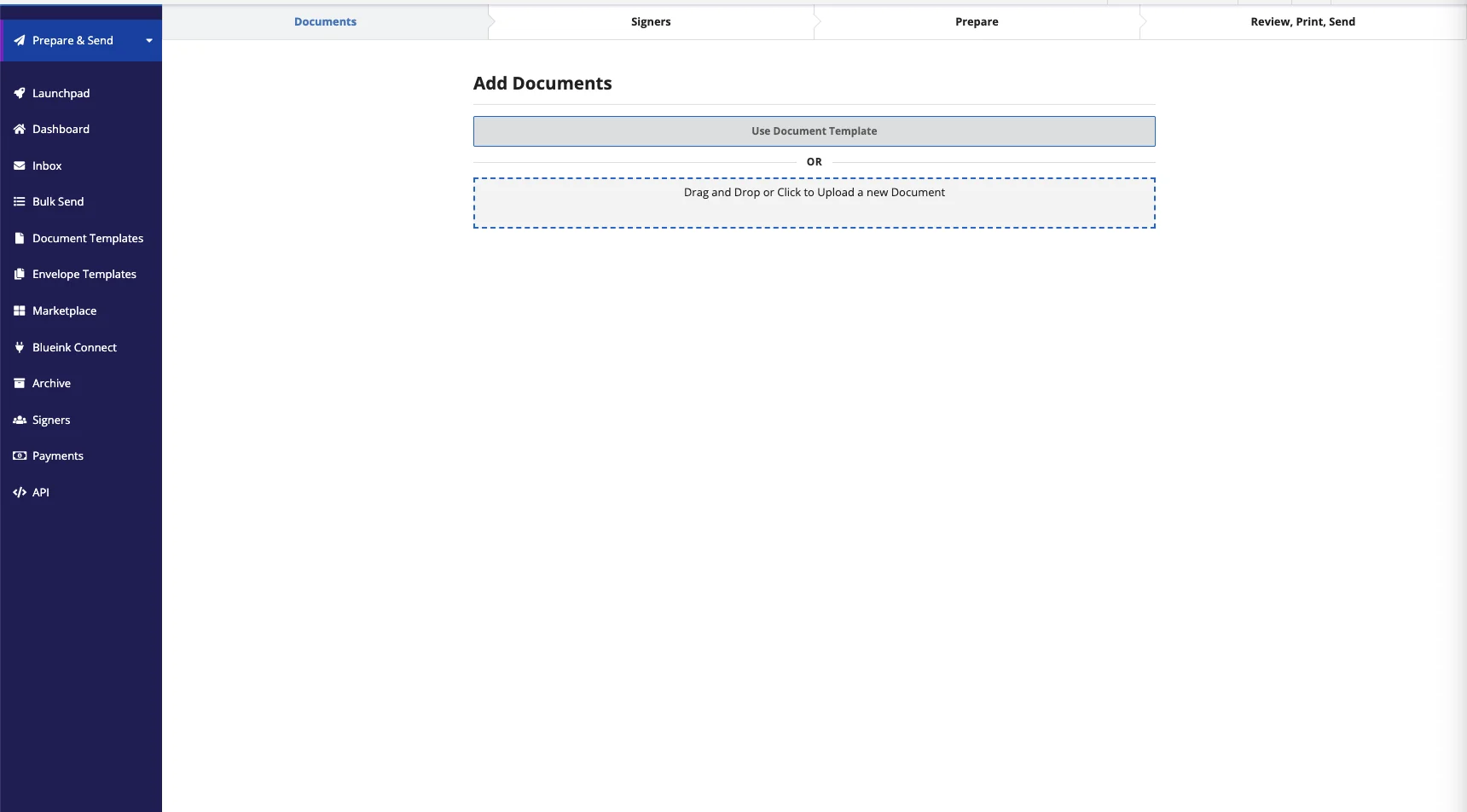
1. Upload the approved agreement. Start a signing workflow and upload the final document. Blueink supports uploading contracts, adding signature fields, and sending them electronically through its contract eSignature workflow.
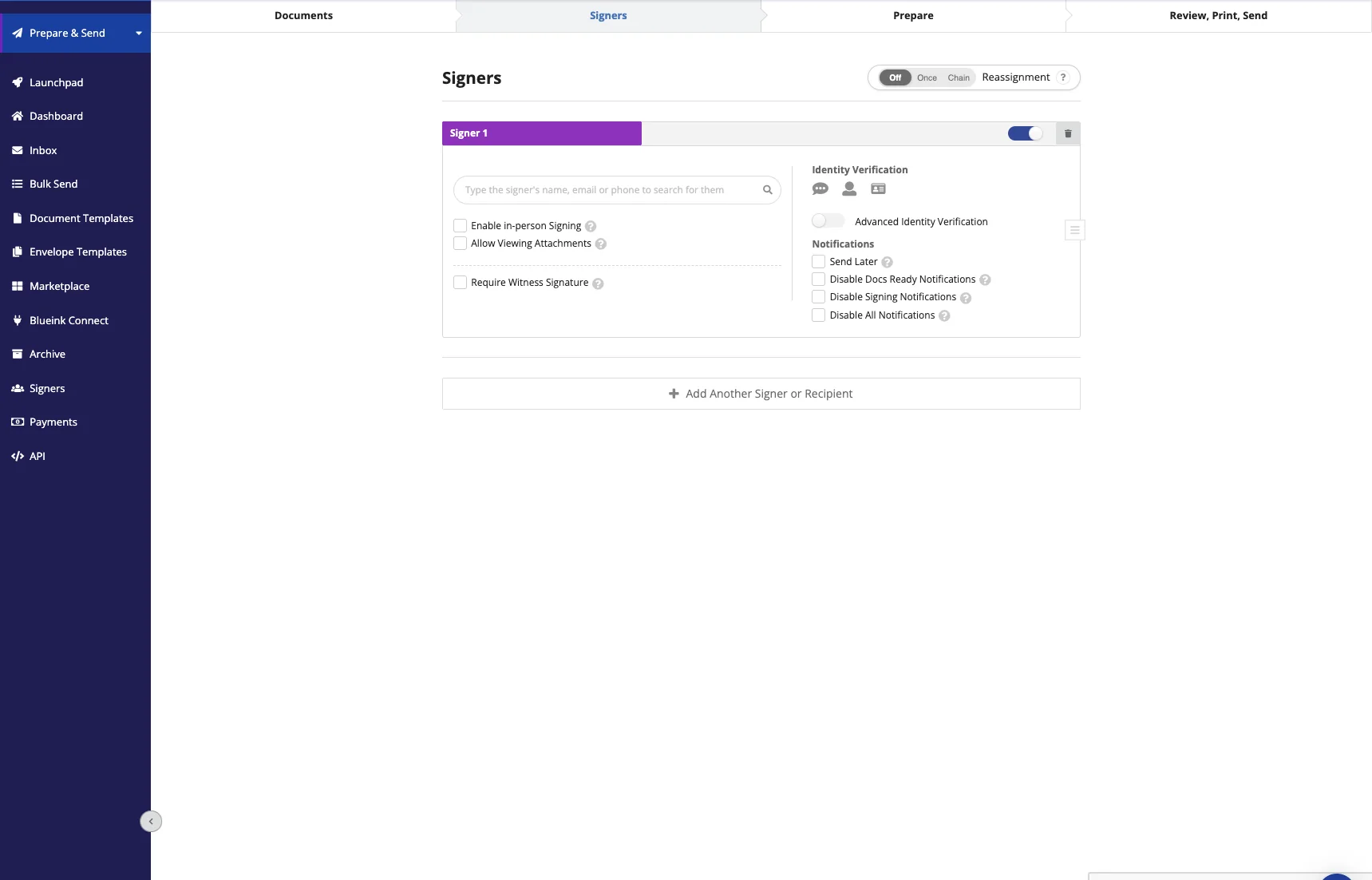
2. Add the contractor and any other required signers. Enter the contractor's information and add an authorized company signer if your process requires a countersignature.
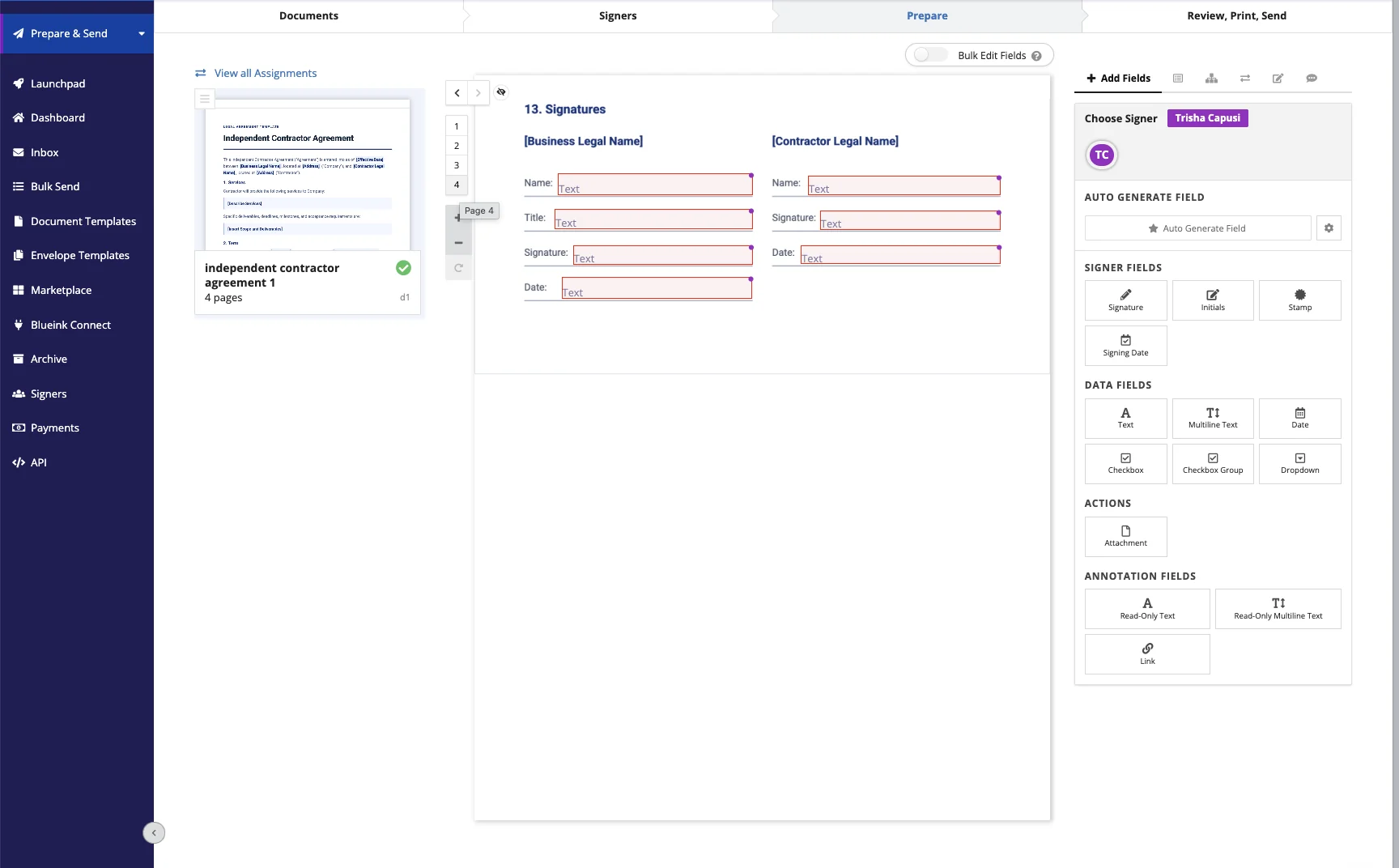
3. Add the required fields. Place signature, date, name, initials, text, or other necessary fields in the document.
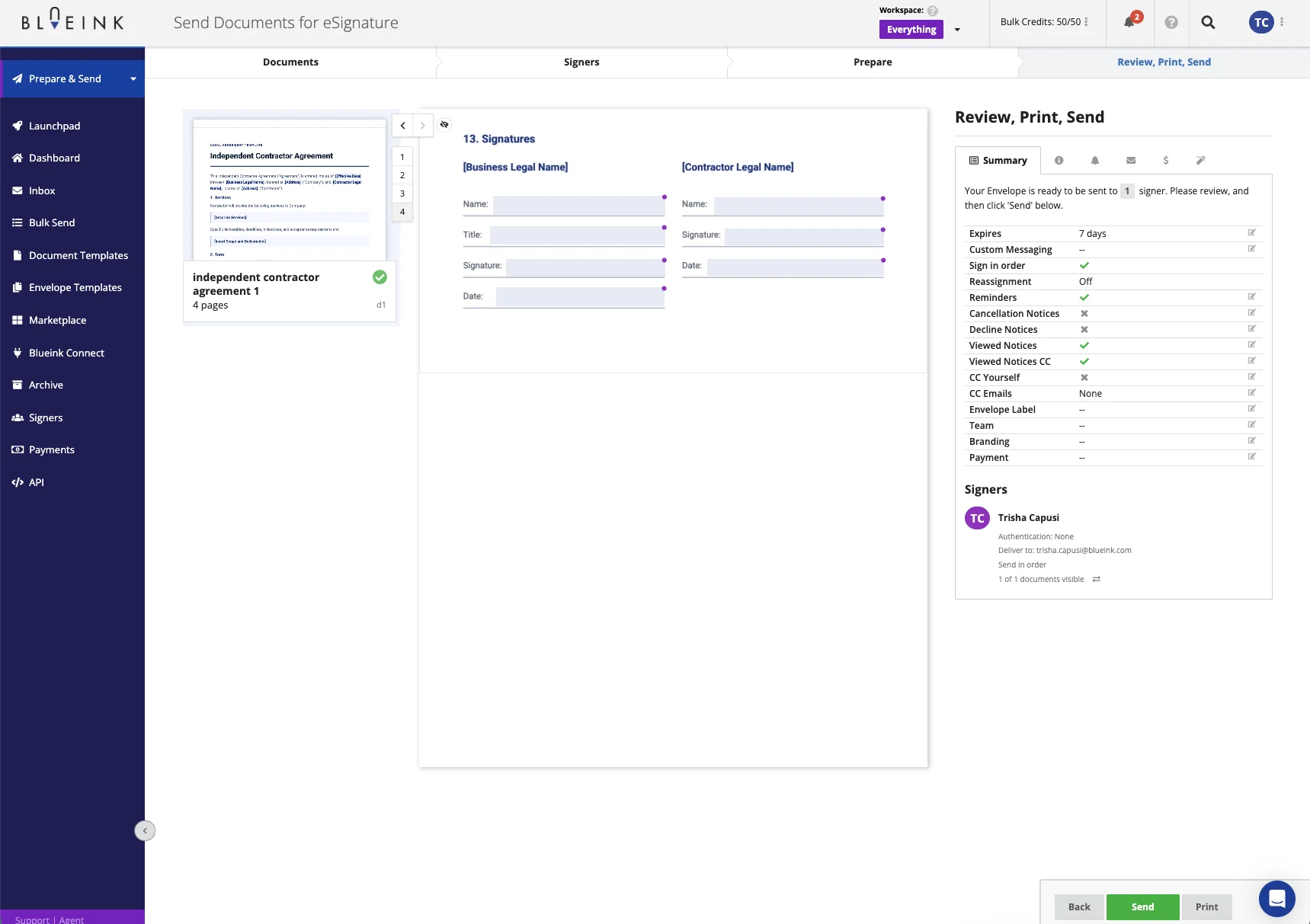
4. Review and send. Confirm the agreement, signer information, and assigned fields before sending the signing request.
5. Track completion. Use Blueink's Real-Time Dashboard to monitor the document after it is sent and see whether the required signatures have been completed.
6. Reuse the agreement when appropriate. If your business regularly engages contractors using the same approved agreement, turn it into a reusable template rather than preparing the document from scratch each time. The Blueink eSignature template library guide explains when to use reusable Document and Envelope Templates.
A reusable template works best when the legal language and workflow remain consistent while details such as the contractor's name, rate, scope, or project dates change from engagement to engagement.
Onboarding Many Contractors at Once With Bulk Send and Templates
Businesses that regularly onboard groups of contractors may need something more efficient than creating every envelope individually.
Blueink's Bulk Send can start from an Envelope Template and create individualized signing requests for multiple recipients. Recipient information can be imported, signer-specific data can be populated, and the resulting batch can be tracked after sending. Bulk Send availability depends on the Blueink plan.
This can be useful for staffing companies, seasonal programs, field operations, or other organizations that need to distribute the same approved contractor agreement to many independent workers.
Put the Agreement in Place Before the Work Starts
An independent contractor agreement gives the business and contractor one place to document the scope, payment terms, ownership rights, confidentiality requirements, termination rules, and other expectations that will govern the engagement.
The strongest agreement is not simply the one with the most clauses. It is the one that accurately reflects the work the parties intend to perform and the relationship they will actually have.
Start with the template above, adapt it to the engagement, and have it reviewed where appropriate. Once the language is approved, a reusable eSignature workflow can make it easier to send the same contractor agreement consistently without rebuilding it each time.
What Should an Independent Contractor Agreement Include?
An independent contractor agreement commonly covers the scope of work, deliverables, deadlines, payment and invoicing terms, contractor status, intellectual property, confidentiality, expenses, term and termination, governing law, and dispute procedures.
The exact provisions should reflect the actual engagement, industry, and applicable law.
Is an Independent Contractor Agreement Legally Binding?
An independent contractor agreement can form a binding contract when the applicable requirements for contract formation and enforceability are satisfied.
Whether particular provisions are enforceable depends on the terms, facts, jurisdiction, and laws involved.
What Is the Difference Between an Independent Contractor Agreement and an MSA?
An independent contractor agreement commonly governs a business's relationship with an individual freelancer or self-employed contractor.
An MSA more often provides an ongoing contractual framework between businesses that expect to complete multiple projects or transactions. Individual projects may then be documented through SOWs or order forms.
There is not one blanket federal rule requiring every independent contractor engagement to use this particular form of written agreement. Specific jurisdictions, industries, or transactions may have their own requirements.
A written agreement is nevertheless useful for documenting scope, payment, intellectual property, confidentiality, termination, and other expectations.
Also remember that a Form 1099 does not determine worker status. The IRS and Department of Labor look at the actual relationship under their respective legal standards.
Can an Independent Contractor Agreement Be Signed Electronically?
Yes, many independent contractor agreements can be executed electronically.
For U.S. transactions within its scope, the ESIGN Act's general rule of validity provides that a contract or signature generally cannot be denied legal effect solely because it is electronic. Other document-specific or jurisdictional requirements can still apply.
Disclaimer Blueink is not a law firm and does not provide legal advice. This page is for informational purposes only and should not be considered a substitute for professional legal counsel. If you have questions about the validity or enforceability of eSignatures or digital signatures, we recommend consulting with a licensed attorney. Use of Blueink’s services is subject to our Terms of Use and Privacy Policy.
As Blueink’s VP of Operations, Elyca oversees the company’s day-to-day operations, ensuring efficiency, quality, and alignment across teams. She writes about operational excellence, process optimization, and scaling systems that support a seamless eSignature experience across industries.
An independent contractor agreement is a contract between a business and a self-employed individual or freelancer that defines the services, deliverables, payment terms, ownership rights, confidentiality duties, and other terms of the engagement. It helps both sides document expectations, but the agreement itself does not determine whether the worker is legally classified as an independent contractor.
For businesses hiring freelancers, consultants, or other project-based workers, putting those expectations in writing can make the working relationship easier to manage from the start.
What Is an Independent Contractor Agreement?
An independent contractor agreement is a written contract between a business and an individual who will provide services as an independent contractor rather than as an employee.
Depending on the work, the agreement may also be described as a contractor agreement, freelance contract, consulting agreement, or independent contractor contract.
The document typically defines:
The services the contractor will provide
Expected deliverables and deadlines
How and when the contractor will be paid
Who owns work created during the engagement
Confidentiality obligations
How long the relationship lasts
How either party can end the agreement
Other responsibilities or restrictions relevant to the work
The agreement is important because it records what the business and contractor have actually agreed to.
If you are comparing different agreements your business may use, Blueink's guide to common types of contracts provides a broader overview.
When Do You Need an Independent Contractor Agreement?
A written agreement is particularly useful whenever a business hires an individual outside its regular workforce to complete defined services.
The more important the deliverables, deadlines, intellectual property, confidential information, or payment terms are to the engagement, the more useful it becomes to document them before work begins.
Freelancers and Consultants
Independent contractor agreements are commonly used when businesses engage individual professionals such as:
Designers
Developers
Writers
Marketing specialists
Photographers
Business consultants
IT professionals
Advisors
A freelance contract can spell out exactly what the freelancer is expected to deliver, when the work is due, how revisions will be handled, and what triggers payment.
For example, a company hiring a freelance designer for a new website might define the number of design concepts, revision rounds, final file formats, delivery dates, and ownership rights in the agreement.
Clear scope language helps prevent a project from slowly expanding beyond what either side originally expected.
Seasonal and Project-Based Workers
Businesses may also engage independent workers for short-term, seasonal, or project-specific needs.
A contractor agreement can establish:
The expected duration of the engagement
Specific tasks or deliverables
Payment rates or project fees
Required completion dates
Equipment or materials responsibilities
Confidentiality requirements
Termination rights
Agencies and Staffing Firms
Agencies and staffing businesses may need to manage agreements with multiple individual contractors working across different projects or client assignments.
The contract can establish the terms between the business and each contractor, while the project details specify the work that individual will perform.
Independent Contractor vs. Employee: Why the Agreement Matters
The distinction between an employee and an independent contractor affects taxes, wage-and-hour protections, benefits, reporting obligations, and other responsibilities. There is no single contract clause that determines the answer.
For federal tax purposes, the IRS explains that worker status depends on the facts of the relationship, including the degree to which the business has the right to control what will be done and how the work will be performed. The IRS also makes clear that simply calling someone an independent contractor does not make them one.
Federal wage-and-hour law uses a separate analysis. In February 2026, the U.S. Department of Labor proposed a new rule that would replace its 2024 guidance with an "economic reality" test. The two core factors are how much control the worker has over the work and the worker's opportunity for profit or loss based on their own initiative or investment. As of October 17, 2026, the proposal has not been finalized.
The proposal also states that "the parties' actual practices are more relevant than what may be contractually or theoretically possible." In other words, a 1099 contractor agreement documents what the parties intend, but it can't override how the relationship actually works. State and local laws may also apply their own tests.
Once a business has determined that the worker is properly treated as an independent contractor for federal tax purposes, the IRS says the contractor should generally complete Form W-9 so the business can obtain the correct taxpayer name and identification number for its records.
Because classification rules can change and may differ by jurisdiction, businesses should review the relationship itself, not simply the wording of the contract.
Key Clauses to Include in an Independent Contractor Agreement
The exact provisions will depend on the work, industry, and jurisdiction, but a practical independent contractor agreement checklist usually covers the following areas.
Scope of Work and Deliverables
The scope should make clear what the contractor is being hired to do. Depending on the project, include:
Services to be provided
Specific deliverables
Project milestones
Deadlines
Acceptance criteria
Revision limits
Responsibilities of the business
Any materials or information the business must provide
Avoid relying on vague language such as "provide consulting services as requested" if the parties actually have a more specific understanding.
For larger projects, the detailed scope can also be attached as an exhibit or separate project schedule.
Payment Terms and Invoicing
State how the contractor will be paid and what must happen before payment becomes due.
The agreement might use:
A fixed project fee
An hourly or daily rate
Milestone payments
A recurring retainer
Another agreed pricing structure
Also address invoice timing, payment deadlines, approved expenses, taxes, and how disputed invoices will be handled.
If the contractor is responsible for submitting invoices, specify what information each invoice should contain.
Independent Contractor Status
The agreement can state that the parties intend to establish an independent contractor relationship rather than employment.
It may also address matters such as responsibility for taxes, benefits, equipment, scheduling, or the contractor's ability to provide services to other clients, where appropriate.
Intellectual Property and Confidentiality
If the contractor is creating intellectual property, the agreement should clearly explain who owns it.
Depending on the work, that could include:
Source code
Designs
Written content
Photography or video
Research
Marketing materials
Inventions
Documentation
Other project deliverables
Do not assume that paying for work automatically resolves every ownership issue. The agreement should state the ownership or licensing arrangement appropriate to the project.
Contractors may also receive access to customer data, pricing, product plans, internal processes, trade secrets, or other sensitive information. Include confidentiality obligations that reflect what the contractor will actually handle.
Define when the agreement begins and when it ends.
For a single project, the agreement might continue until the services are completed. An ongoing contractor relationship may use a fixed term or continue until either party terminates it.
Consider addressing:
Required termination notice
Termination for breach
Payment for completed work
Treatment of unfinished deliverables
Return of company property
Confidential information after termination
Intellectual property created before termination
Provisions that survive the end of the agreement
The agreement should also identify applicable governing law and how disputes will be handled.
These provisions can materially affect the parties' rights, so they should be reviewed for the particular engagement rather than copied mechanically from another contract.
Free Independent Contractor Agreement Template
Important: This free independent contractor agreement template is a general starting point for business use. It is not legal advice and is not designed for every industry, jurisdiction, or working relationship. Have qualified legal counsel review and adapt the agreement before relying on it.
This Independent Contractor Agreement ("Agreement") is entered into as of [Effective Date] between [Business Legal Name], located at [Address] ("Company"), and [Contractor Legal Name], located at [Address] ("Contractor").
1. Services
Contractor will provide the following services to Company:
[Describe Services]
Specific deliverables, deadlines, milestones, and acceptance requirements are:
[Insert Scope and Deliverables]
2. Term
This Agreement begins on [Start Date] and will continue until [End Date / Completion of Services / Terminated Under This Agreement].
3. Compensation
Company will pay Contractor [Hourly Rate / Fixed Fee / Milestone Amount / Other Compensation].
Contractor will submit invoices [Frequency], and approved invoices will be payable within [X] days.
Approved expenses will be handled as follows:
[Insert Expense Terms]
4. Independent Contractor Relationship
The parties intend for Contractor to provide the services as an independent contractor and not as an employee of Company.
Nothing in this Agreement is intended to override or determine worker status where applicable law requires a different classification. The parties will perform their obligations in a manner consistent with applicable law and the actual nature of their working relationship.
5. Taxes and Records
Contractor will be responsible for taxes and reporting obligations applicable to Contractor's properly classified independent business activities.
Contractor will provide Company with a completed Form W-9 and other information reasonably required for applicable tax reporting.
6. Intellectual Property
Ownership and permitted use of deliverables, pre-existing materials, intellectual property, and licensed materials will be handled as follows:
[Insert Intellectual Property Terms]
7. Confidentiality
Contractor will protect Company's confidential information and use it only as necessary to perform the services.
The parties should define what information is confidential, applicable exceptions, permitted disclosures, required safeguards, and how long confidentiality obligations will continue.
8. Equipment and Expenses
Responsibility for equipment, software, supplies, travel, and other project expenses will be:
[Insert Terms]
9. Representations and Compliance
Each party will comply with the laws and contractual obligations applicable to its performance under this Agreement.
Any required licenses, insurance, security standards, or industry-specific obligations should be listed here:
[Insert Requirements]
10. Termination
Either party may terminate this Agreement under the following circumstances:
[Insert Notice Period and Termination Rights]
Upon termination, the parties will address unpaid fees, unfinished work, Company property, confidential information, and intellectual property as follows:
[Insert Terms]
11. Governing Law and Disputes
This Agreement will be governed by the laws of [Jurisdiction].
Disputes will be handled through [Negotiation / Mediation / Arbitration / Litigation / Other Process].
12. General Terms
Include any additional provisions appropriate to the engagement, such as notices, assignment, subcontracting, amendments, waiver, severability, entire agreement, force majeure, and electronic signatures.
13. Signatures
[Business Legal Name]
Name:
Title:
Signature:
Date:
[Contractor Legal Name]
Name:
Signature:
Date:
Click blue placeholders to customize this template. This document is for informational purposes and should be reviewed for applicable legal requirements.
What to Customize Before You Send It
Before using the template, make sure it reflects the actual engagement rather than simply filling in the parties' names. At minimum, review:
Scope and deliverables. Describe what the contractor is expected to produce and when.
Intellectual property. Decide who owns the final work and how pre-existing materials will be handled.
Confidentiality. Match the confidentiality requirements to the information the contractor will actually access.
Equipment and access. Clarify responsibility for tools, software, accounts, devices, and company systems.
Term and termination. Explain how long the relationship lasts and what happens when it ends.
Taxes and documentation. Obtain required tax information, including Form W-9 where applicable.
Governing law and disputes. Use terms appropriate to the relevant jurisdiction.
Industry-specific requirements. Add insurance, licensing, data-security, or regulatory terms where the work requires them.
For engagements with meaningful legal, tax, employment, or intellectual-property implications, have qualified counsel review the final agreement.
Once the language is approved, teams that send the same agreement repeatedly can turn it into a reusable digital workflow. Blueink's guide to building an eSignature template library covers how recurring documents can be standardized instead of rebuilt for each new signer.
How This Agreement Differs From an MSA
An independent contractor agreement usually governs the relationship between a business and an individual freelancer or contractor performing defined services. A master service agreement (MSA) more commonly establishes a reusable business-to-business framework for multiple projects or transactions over time.
Independent Contractor Agreement
MSA
Commonly used to engage an individual contractor or freelancer
Commonly used between businesses
Covers the contractor relationship and services
Establishes recurring legal and commercial terms
Often contains the project scope directly
Project details may be handled through SOWs or order forms
If the person providing services operates through a separate vendor organization, a vendor agreement workflow or an MSA may be more appropriate depending on the relationship. For more detail on SOWs and recurring business-to-business engagements, see the linked MSA guide.
How to Send and Sign an Independent Contractor Agreement Online
Once the agreement has been reviewed and the parties are ready to execute it, the document can often be signed electronically.
For transactions within its scope, the federal ESIGN Act generally provides that a contract or signature cannot be denied legal effect solely because it is electronic. Other requirements may still apply depending on the agreement, transaction, and jurisdiction.
That makes eSignature practical for many contractor agreements without changing the underlying responsibility to use an appropriate agreement.
Signing With Blueink
Once your independent contractor agreement is finalized:
1. Upload the approved agreement. Start a signing workflow and upload the final document. Blueink supports uploading contracts, adding signature fields, and sending them electronically through its contract eSignature workflow.
2. Add the contractor and any other required signers. Enter the contractor's information and add an authorized company signer if your process requires a countersignature.
3. Add the required fields. Place signature, date, name, initials, text, or other necessary fields in the document.
4. Review and send. Confirm the agreement, signer information, and assigned fields before sending the signing request.
5. Track completion. Use Blueink's Real-Time Dashboard to monitor the document after it is sent and see whether the required signatures have been completed.
6. Reuse the agreement when appropriate. If your business regularly engages contractors using the same approved agreement, turn it into a reusable template rather than preparing the document from scratch each time. The Blueink eSignature template library guide explains when to use reusable Document and Envelope Templates.
A reusable template works best when the legal language and workflow remain consistent while details such as the contractor's name, rate, scope, or project dates change from engagement to engagement.
Onboarding Many Contractors at Once With Bulk Send and Templates
Businesses that regularly onboard groups of contractors may need something more efficient than creating every envelope individually.
Blueink's Bulk Send can start from an Envelope Template and create individualized signing requests for multiple recipients. Recipient information can be imported, signer-specific data can be populated, and the resulting batch can be tracked after sending. Bulk Send availability depends on the Blueink plan.
This can be useful for staffing companies, seasonal programs, field operations, or other organizations that need to distribute the same approved contractor agreement to many independent workers.
Put the Agreement in Place Before the Work Starts
An independent contractor agreement gives the business and contractor one place to document the scope, payment terms, ownership rights, confidentiality requirements, termination rules, and other expectations that will govern the engagement.
The strongest agreement is not simply the one with the most clauses. It is the one that accurately reflects the work the parties intend to perform and the relationship they will actually have.
Start with the template above, adapt it to the engagement, and have it reviewed where appropriate. Once the language is approved, a reusable eSignature workflow can make it easier to send the same contractor agreement consistently without rebuilding it each time.
What Should an Independent Contractor Agreement Include?
An independent contractor agreement commonly covers the scope of work, deliverables, deadlines, payment and invoicing terms, contractor status, intellectual property, confidentiality, expenses, term and termination, governing law, and dispute procedures.
The exact provisions should reflect the actual engagement, industry, and applicable law.
Is an Independent Contractor Agreement Legally Binding?
An independent contractor agreement can form a binding contract when the applicable requirements for contract formation and enforceability are satisfied.
Whether particular provisions are enforceable depends on the terms, facts, jurisdiction, and laws involved.
What Is the Difference Between an Independent Contractor Agreement and an MSA?
An independent contractor agreement commonly governs a business's relationship with an individual freelancer or self-employed contractor.
An MSA more often provides an ongoing contractual framework between businesses that expect to complete multiple projects or transactions. Individual projects may then be documented through SOWs or order forms.
There is not one blanket federal rule requiring every independent contractor engagement to use this particular form of written agreement. Specific jurisdictions, industries, or transactions may have their own requirements.
A written agreement is nevertheless useful for documenting scope, payment, intellectual property, confidentiality, termination, and other expectations.
Also remember that a Form 1099 does not determine worker status. The IRS and Department of Labor look at the actual relationship under their respective legal standards.
Can an Independent Contractor Agreement Be Signed Electronically?
Yes, many independent contractor agreements can be executed electronically.
For U.S. transactions within its scope, the ESIGN Act's general rule of validity provides that a contract or signature generally cannot be denied legal effect solely because it is electronic. Other document-specific or jurisdictional requirements can still apply.
{ "@type": "Question", "name": "What Should an Independent Contractor Agreement Include?", "acceptedAnswer": { "@type": "Answer", "text": "An independent contractor agreement commonly covers the scope of work, deliverables, deadlines, payment and invoicing terms, contractor status, intellectual property, confidentiality, expenses, term and termination, governing law, and dispute procedures. The exact provisions should reflect the actual engagement, industry, and applicable law." } }, { "@type": "Question", "name": "Is an Independent Contractor Agreement Legally Binding?", "acceptedAnswer": { "@type": "Answer", "text": "An independent contractor agreement can form a binding contract when the applicable requirements for contract formation and enforceability are satisfied. Whether particular provisions are enforceable depends on the terms, facts, jurisdiction, and laws involved." } }, { "@type": "Question", "name": "What Is the Difference Between an Independent Contractor Agreement and an MSA?", "acceptedAnswer": { "@type": "Answer", "text": "An independent contractor agreement commonly governs a business's relationship with an individual freelancer or self-employed contractor. An MSA more often provides an ongoing contractual framework between businesses that expect to complete multiple projects or transactions. Individual projects may then be documented through SOWs or order forms. See Blueink's guide to a master service agreement (MSA) for a detailed explanation: https://www.blueink.com/blog/master-service-agreement-template" } }, { "@type": "Question", "name": "Do I Need a Contract for a 1099 Contractor?", "acceptedAnswer": { "@type": "Answer", "text": "There is not one blanket federal rule requiring every independent contractor engagement to use this particular form of written agreement. Specific jurisdictions, industries, or transactions may have their own requirements. A written agreement is nevertheless useful for documenting scope, payment, intellectual property, confidentiality, termination, and other expectations. Also remember that a Form 1099 does not determine worker status. The IRS and Department of Labor look at the actual relationship under their respective legal standards." } }, { "@type": "Question", "name": "Can an Independent Contractor Agreement Be Signed Electronically?", "acceptedAnswer": { "@type": "Answer", "text": "Yes, many independent contractor agreements can be executed electronically." } }