

What Is a Master Service Agreement? Definition, Key Clauses, and Free Template

A master service agreement (MSA) is a contract that establishes the core legal and commercial terms for an ongoing relationship between two businesses, usually a service provider and a customer. Instead of renegotiating confidentiality, liability, payment rules, intellectual property, dispute procedures, and other foundational terms for every new project, the parties agree to those terms once in the MSA.
Individual projects can then be documented through shorter Statements of Work (SOWs), order forms, or similar documents covering the work, deliverables, timeline, and price.
That structure makes MSAs particularly useful for businesses that expect to work together more than once. The MSA establishes the rules of the relationship; each SOW defines what the parties are doing under those rules.
What Is a Master Service Agreement (MSA)?
A master service agreement, also commonly called a master services agreement, is a framework contract designed to govern multiple transactions or projects between the same parties.
According to the American Bar Association, MSAs are master documents that can govern multiple agreements or transactions between businesses.
A typical MSA establishes terms that are expected to remain relatively stable throughout the relationship, such as:
- Payment rules
- Confidentiality
- Intellectual property ownership
- Warranties
- Limitations of liability
- Indemnification
- Insurance requirements
- Term and termination
- Governing law
- Dispute resolution
Project-specific details can then be handled separately through SOWs, order forms, or similar documents.
For example, a marketing agency and a client might sign one MSA establishing confidentiality, payment procedures, intellectual property rights, and liability rules. The parties could then sign separate SOWs for a website redesign, paid-media campaign, and content program.
How an MSA Differs From a Standard Contract
An MSA is a contract. The difference is what it is designed to govern.
A one-time services contract often combines the general legal terms and the details of one specific project into a single agreement. An MSA separates those layers.
This does not mean every recurring relationship needs an MSA. If the engagement is simple, short, or genuinely one-off, a single services agreement may be easier.
When Do You Need a Master Service Agreement?
An MSA becomes more useful when two businesses expect the relationship to continue but cannot define every future project at the beginning.
The main advantage is not simply having a longer contract. It is separating the terms that should remain consistent from the details that will change from project to project.
SaaS and Recurring Vendor Relationships
Technology and SaaS relationships can involve more than the initial software purchase.
A customer may begin with a subscription and later add implementation services, training, integrations, professional services, additional products, or expanded usage.
An MSA can establish the relationship-level framework while order forms or SOWs document individual purchases or services.
This structure can also be useful for IT providers, consultants, managed service providers, and other vendors whose work develops in phases. For a closer look at how digital signatures fit into these workflows, see Blueink's guide to eSignature for SaaS companies.
Agencies and Ongoing Client Work
Agencies commonly work with the same client across multiple projects.
A client might initially hire an agency for branding, then add a website project, social media management, video production, or another campaign later.
With an MSA in place, the parties can use individual SOWs to define the services, deliverables, schedule, fees, project assumptions, client responsibilities, and acceptance criteria for each engagement.
For agencies managing these agreements digitally, Blueink also covers eSignature for marketing agencies, including client contracts, SOWs, and NDAs.
Procurement and Long-Term Supplier Terms
Procurement teams may also use MSAs for vendors that provide recurring services over time.
The MSA can establish the supplier relationship while separate SOWs, purchase orders, or work orders define each engagement.
Teams can use eSignature for procurement workflows to connect document signing with their existing procurement processes. Blueink supports vendor agreement eSignature workflows through reusable templates, sending to multiple vendors at once, real-time tracking, and integrations with procurement or ERP systems.
Master Service Agreement vs. Statement of Work (SOW)
An MSA and a Statement of Work usually serve different purposes, even when they are part of the same contractual relationship.
The easiest distinction is: The MSA defines the rules of the relationship. The SOW defines the work for a particular engagement.
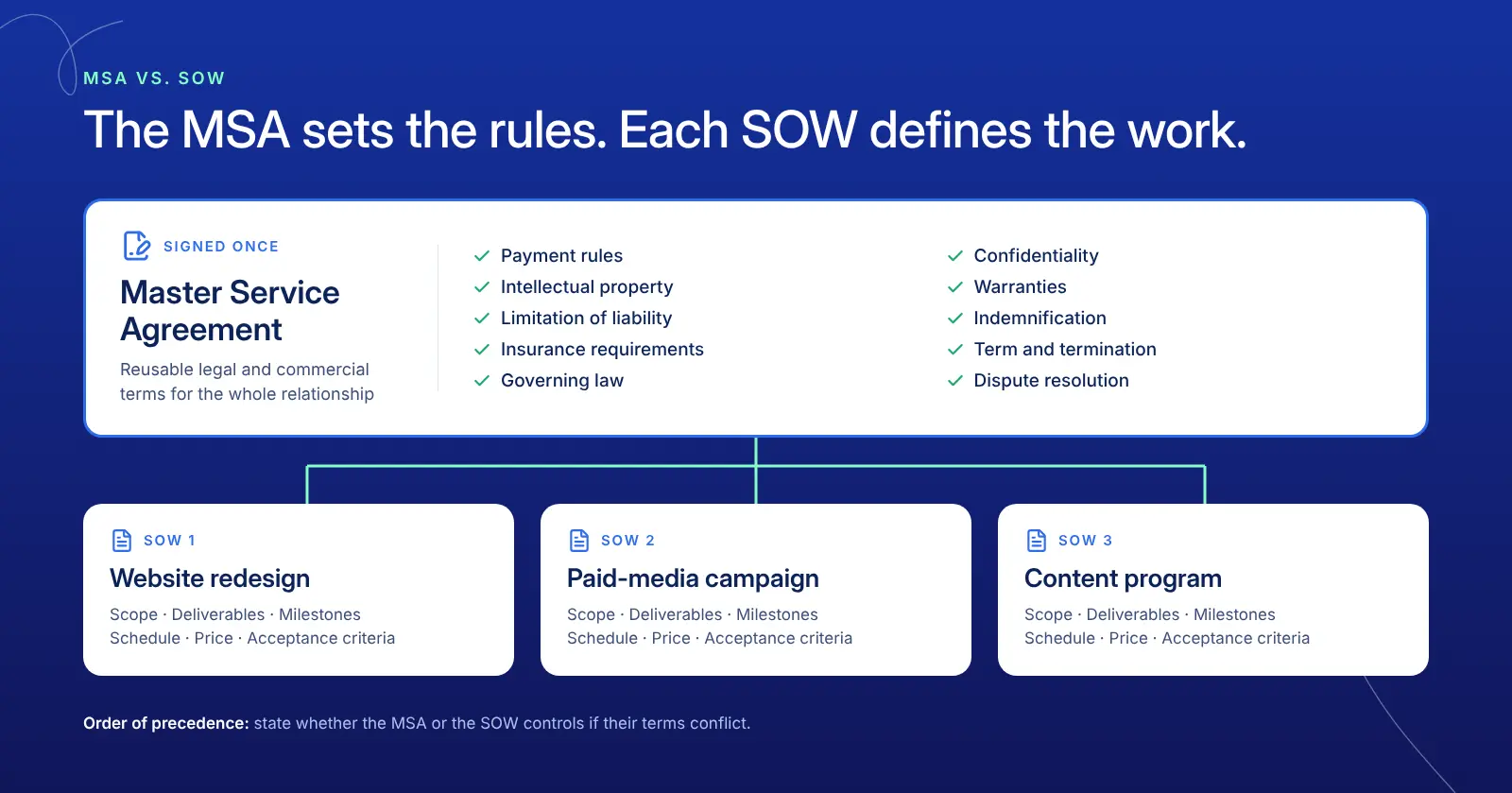
A well-structured MSA generally contains the terms the parties do not want to renegotiate every time they start a new project. Each SOW then provides the commercial and operational details for one piece of work.
What Stays in the MSA vs. What Goes in Each SOW
A common division looks like this:
The exact split depends on how the parties structure their contracts.
One important drafting issue is precedence. If an SOW conflicts with the MSA, the documents should make clear which one controls. That is especially important when project teams add terms to an SOW that differ from the framework agreement.
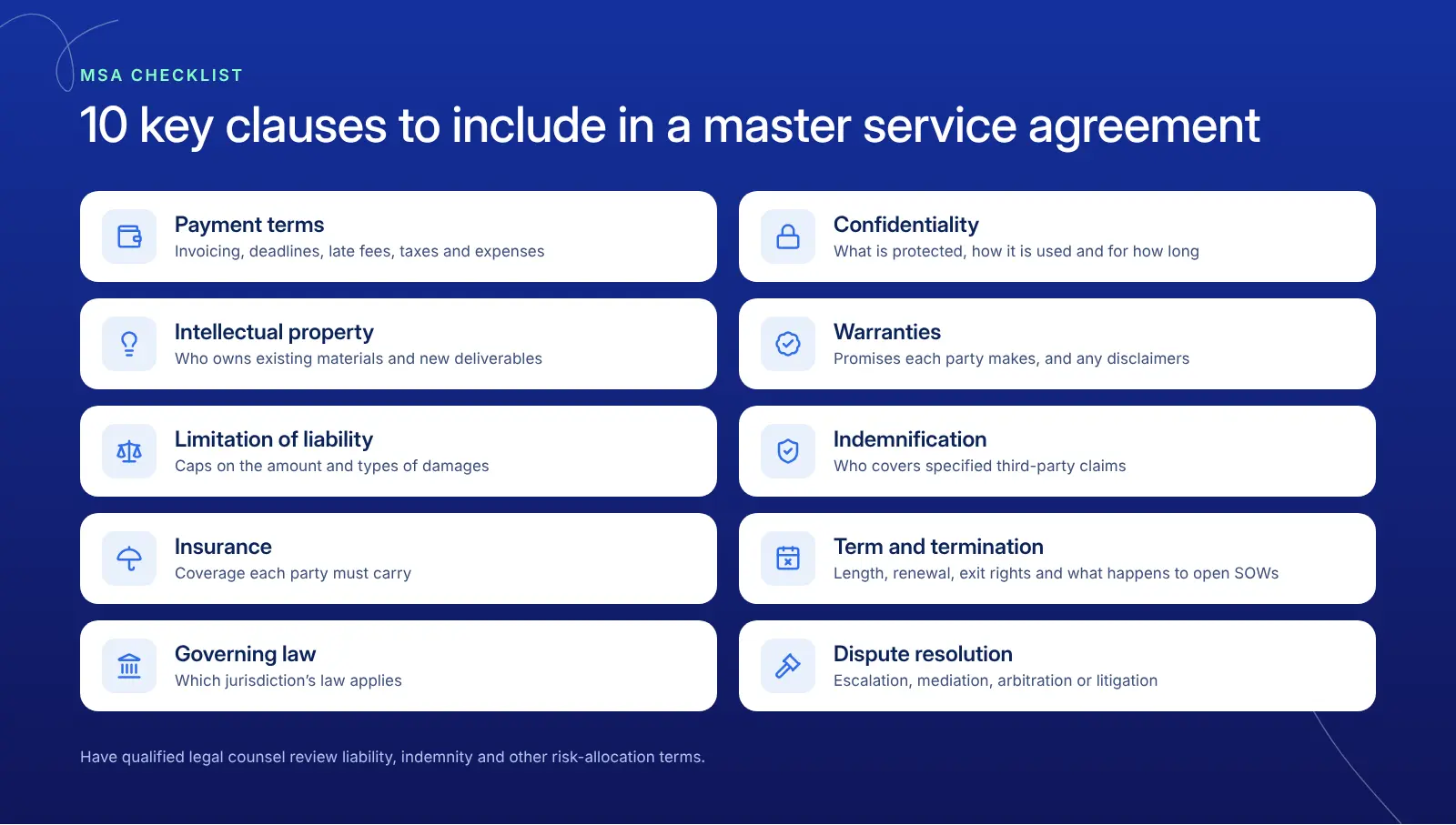
Key Clauses Every MSA Should Include
There is no universal MSA that works for every company, industry, or jurisdiction.
The provisions should reflect the services being provided, how the parties work together, the risks involved, and the law governing the relationship.
Still, several clauses commonly appear in master service agreements.
Scope, Payment Terms, and Term/Termination
Scope framework. The MSA should explain how future services will be authorized. That may be through signed SOWs, order forms, purchase orders, or another agreed process.
It should also make clear whether the MSA itself commits either party to buy or provide any minimum amount of work.
Payment terms. The agreement can establish recurring rules around invoicing, payment deadlines, late payments, taxes, reimbursable expenses, and disputed charges. Individual SOWs can then provide project-specific pricing.
Term and termination. The MSA should state when it begins, how long it lasts, whether it renews, and how either party may terminate it.
The agreement should also address what happens to active SOWs after the MSA terminates. Depending on the drafting, an existing SOW might continue until completion or terminate along with the MSA.
Liability, Indemnification, and Confidentiality
These clauses often receive significant attention because they determine how risk is divided between the parties.
Limitation of liability. This provision may limit the amount or types of damages one party can recover from the other. The appropriate structure depends heavily on the relationship and applicable law.
Indemnification. An indemnity clause establishes circumstances in which one party agrees to protect or compensate the other for specified third-party claims or losses.
Confidentiality. Because ongoing service relationships frequently involve access to confidential business, customer, technical, or financial information, MSAs commonly define what information is protected, permitted uses, required safeguards, exceptions, and how long confidentiality duties continue.
Depending on the services involved, the MSA may also need separate provisions dealing with data protection, cybersecurity, intellectual property, insurance, warranties, or subcontractors.
Governing Law and Dispute Resolution
Because contract law can differ between jurisdictions, the MSA should identify which jurisdiction's law governs the agreement.
The dispute-resolution section can also establish how the parties will address disagreements. Depending on the contract, this could include escalation between business representatives, mediation, arbitration, litigation, or a combination of approaches.
The provisions should also address where a dispute will be heard when relevant.
These are legal risk-allocation decisions rather than boilerplate details. Businesses should have qualified counsel review provisions that could materially affect their rights or exposure.
Free Master Service Agreement Template
The following master service agreement template is a general starting framework, not a finished contract for every business or jurisdiction.
It is intended to help teams organize the sections they may need before having the agreement reviewed for their circumstances.
MASTER SERVICE AGREEMENT
This Master Service Agreement ("Agreement") is entered into as of [Effective Date] between [Provider Legal Name], located at [Address] ("Provider"), and [Customer Legal Name], located at [Address] ("Customer").
1. Services
Provider may perform services for Customer under one or more Statements of Work ("SOWs") executed by the parties.
Each SOW will describe the applicable services, deliverables, schedule, fees, and other project-specific requirements.
2. Statements of Work
No project will begin unless authorized in an SOW or other written work authorization agreed to by the parties.
Each SOW will be governed by this Agreement unless the SOW expressly states otherwise.
3. Fees and Payment
Customer will pay Provider the fees stated in each SOW.
Invoices are due within [X] days of receipt. The parties will address approved expenses, taxes, disputed invoices, and any applicable late-payment terms as follows: [Insert Terms].
4. Customer Responsibilities
Customer will provide the access, information, approvals, personnel, materials, and other cooperation reasonably required to perform the applicable services.
5. Intellectual Property
Ownership of pre-existing materials, project deliverables, licensed materials, and other intellectual property will be handled as follows: [Insert IP Terms].
6. Confidentiality
Each party will protect the other party's confidential information and use it only for purposes permitted under this Agreement.
Define applicable exclusions, required safeguards, permitted disclosures, and the duration of confidentiality obligations.
7. Warranties
Each party provides the warranties expressly stated in this Agreement or an applicable SOW.
Specify any warranties, disclaimers, remedies, or service commitments appropriate to the relationship.
8. Indemnification
The parties' respective indemnification obligations are: [Insert Indemnification Terms].
9. Limitation of Liability
The parties' agreed limitations and exclusions of liability are: [Insert Liability Terms].
10. Term and Termination
This Agreement begins on the Effective Date and continues until [Expiration/Renewal Terms] unless terminated earlier under this section.
Either party may terminate the Agreement under the following circumstances: [Insert Termination Rights].
Specify what happens to active SOWs, unpaid fees, confidential information, intellectual property, and provisions intended to survive termination.
11. Governing Law and Dispute Resolution
This Agreement will be governed by the laws of [Jurisdiction].
Disputes will be resolved through [Negotiation/Mediation/Arbitration/Litigation] according to the following process: [Insert Process].
12. General Provisions
Include any applicable provisions concerning:
- Notices
- Assignment
- Subcontractors
- Force majeure
- Independent contractor status
- Amendments
- Waivers
- Severability
- Entire agreement
- Order of precedence
- Counterparts and electronic signatures
13. Signatures
[Provider Legal Name]
Name: ____________________
Title: ____________________
Signature: ________________
Date: _____________________
[Customer Legal Name]
Name: ____________________
Title: ____________________
Signature: ________________
Date: _____________________
What to Customize Before You Send It
A template should never be treated as a substitute for thinking through the actual business relationship.
Before sending an MSA, confirm at minimum:
- The exact legal names of both parties. Make sure the entities signing the agreement are correctly identified.
- How work will be authorized. Define whether new projects require an SOW, order form, purchase order, or another document.
- Payment mechanics. Set invoicing rules, payment deadlines, expenses, taxes, and project-specific pricing.
- Intellectual property ownership. Clarify what each party already owns and what happens to IP created during the work.
- Confidentiality and data obligations. Match the provisions to the actual information the parties will handle.
- Liability and indemnification. These clauses can materially affect financial exposure and deserve careful review.
- Term and termination. Explain not only how the MSA ends but what happens to open SOWs.
- Document precedence. State whether the MSA or an SOW controls if their terms conflict.
- Governing law and disputes. Choose terms appropriate to the parties and jurisdictions involved.
- Signature authority. Confirm that the individuals signing are authorized to bind their respective organizations.
For contracts that create meaningful legal or financial exposure, have the final agreement reviewed by qualified legal counsel.
How to Sign a Master Service Agreement Online
Once the terms are final and the appropriate people have approved the agreement, an MSA can often move into an electronic signing workflow.
Under the federal Electronic Signatures in Global and National Commerce Act, a contract or signature involved in interstate or foreign commerce generally cannot be denied legal effect solely because it is electronic. The Act does not eliminate other legal requirements that may apply to a particular transaction.
In the U.S., the ESIGN Act and state laws based on the Uniform Electronic Transactions Act (UETA) provide the legal framework for many electronic transactions. Blueink's guide to ESIGN and UETA explains how these laws apply to eSignatures. Agreements involving non-U.S. parties may be subject to other electronic-signature laws, such as eIDAS in the European Union.
That makes eSignature practical for many business MSAs, provided the agreement and signing process satisfy the applicable requirements.
Why eSignature Speeds Up MSA Execution
MSAs frequently involve people working in different companies, offices, cities, or countries.
A paper process can require someone to print the final document, sign it, scan it, send it to the next person, and then reconcile the completed versions.
An eSignature workflow removes many of those handoffs.
It can help teams:
- Send the final agreement immediately
- Collect signatures from multiple parties
- Control signing order when needed
- Send reminders for outstanding signatures
- Track whether each signer has completed their part
- Keep the completed agreement with a record of the signing activity
The biggest benefit comes after the negotiation is finished. eSignature does not replace legal review or negotiation; it makes execution of the approved document easier to manage.
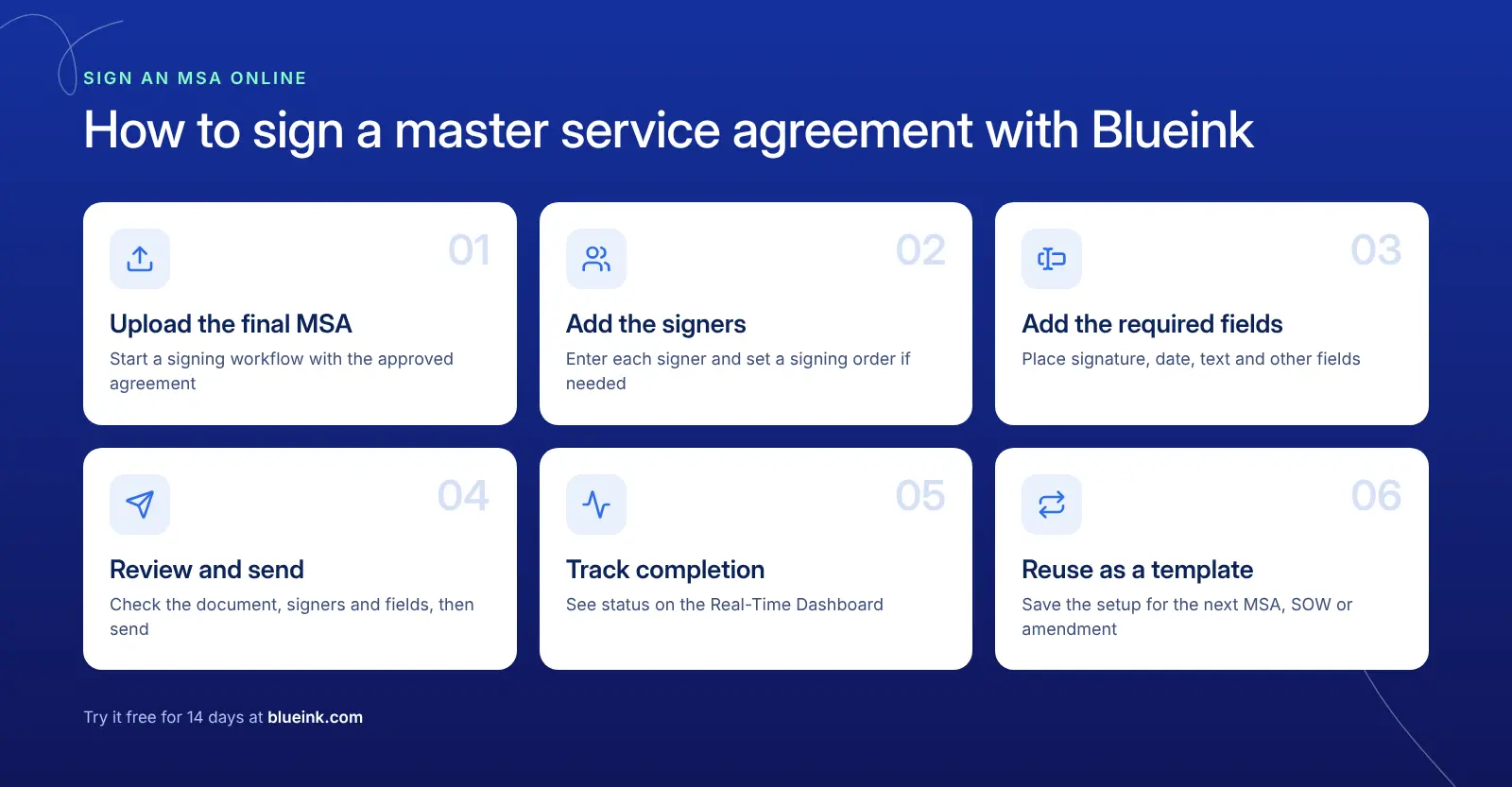
Signing an MSA With Blueink
Blueink can handle the execution stage once your Master Service Agreement is ready to sign.
1. Upload the final MSA.
Start a new signing workflow and upload the approved agreement. Blueink supports contract preparation through its online contract signing workflow.
2. Add the signers.
Enter the people who need to execute the agreement. If signatures need to happen sequentially, Blueink allows teams to set a signing order.
3. Add the required fields.
Place signature, date, text, and other required fields where they belong in the agreement.
4. Review and send.
Confirm the document, signer information, and fields before sending the MSA.
5. Track completion.
Use Blueink's Real-Time Dashboard to see where the signing process stands and identify agreements that still need action.
6. Reuse the workflow when appropriate.
If your business sends the same approved MSA structure repeatedly, you can create a reusable template in Blueink instead of configuring the document from scratch for every customer or vendor.
Once the MSA is established, the same approach can be used for SOWs, amendments, renewals, and other documents that later require execution.
Teams that regularly send agreements can start a free 14-day Blueink trial to test the contract signing workflow.
Common Mistakes to Avoid in an MSA
An MSA is supposed to make an ongoing relationship easier to manage. Poor drafting can do the opposite.
Treating the MSA and SOW as the Same Document
Keep recurring legal terms and project-specific details clearly separated when using an MSA/SOW structure.
Putting every project detail into the MSA defeats much of the reason for creating a reusable framework.
Leaving the Order of Precedence Unclear
An SOW may eventually contain language that conflicts with the MSA.
The agreements should establish what happens in that situation rather than leaving the answer for the parties to argue about later.
Using Vague Scope Language
Even when individual project scope belongs in the SOW, the MSA should clearly describe how work becomes authorized and how changes are handled.
A vague framework combined with vague SOWs can create uncertainty over what either party actually promised to do.
Ignoring What Happens After Termination
Ending the MSA does not automatically answer what happens to an active project.
The agreement should address outstanding fees, ongoing SOWs, confidential information, intellectual property, data return or deletion where applicable, and provisions that survive termination.
Copying Liability or Indemnity Language Without Reviewing It
Liability and indemnification provisions allocate meaningful financial and legal risk.
Language copied from another company's agreement may reflect a completely different service, risk profile, jurisdiction, or negotiating position.
Forgetting About Future SOWs
The MSA should work as a framework for the relationship you expect to have, not only the project happening today.
Think about how new SOWs are approved, how pricing can vary, who is authorized to sign them, what happens when terms conflict, and whether amendments to the MSA need to be in writing.
Treating the Template as Legal Advice
A free MSA template is a starting point for organizing a contract, not a determination that the terms are suitable or enforceable for a particular business.
Contract enforceability depends on applicable law and the circumstances of the agreement. Basic contract principles typically include mutual assent, consideration, capacity, and a lawful purpose, as explained in Cornell Law School's overview of contracts.
Make the MSA Easier to Execute and Reuse
A well-structured master service agreement can simplify an ongoing business relationship by putting the recurring legal and commercial rules in one place.
The MSA sets the framework. SOWs or order forms can define individual projects. Once the agreement is negotiated and approved, eSignature can remove unnecessary friction from getting it executed.
For businesses that repeatedly work with the same MSA structure, reusable templates can make the process even more efficient by preserving signer roles and document fields for future agreements.
Schedule a demo to see how Blueink handles MSA, SOW, and amendment signing in one workflow.
Frequently Asked Questions
What Is the Difference Between an MSA and a Contract?
An MSA is a type of contract. What makes it different is its purpose: it establishes reusable terms for an ongoing relationship rather than describing only one project or transaction.
A one-time services contract may combine the legal framework, scope, schedule, and price in one document. Under an MSA structure, the relationship-level terms stay in the MSA while individual SOWs or order forms describe specific work.
Does a Master Service Agreement Need to Be Signed Every Time You Start New Work?
Usually not if the MSA was designed to govern future engagements and remains in effect.
Instead, the parties generally execute a new SOW, order form, or other project document that references the existing MSA. Whether a particular SOW itself requires signatures depends on the contracts and the parties' agreed process.
Is an MSA Legally Binding Without a Lawyer?
A lawyer does not generally have to draft or sign a business agreement for it to become a contract. Contract enforceability depends on applicable law and factors such as mutual assent, consideration, capacity, lawful purpose, and any formal requirements that apply to the transaction.
Because MSAs can allocate substantial rights and risks through provisions such as indemnification, intellectual property, liability, and termination, obtaining qualified legal review can still be valuable even when it is not a condition of contract formation.
Can a Master Service Agreement Be Signed Electronically?
Yes, many MSAs can be signed electronically.
For U.S. transactions within its scope, the ESIGN Act's general rule of validity provides that contracts and signatures cannot be denied legal effect solely because they are electronic. Other laws or requirements may still apply depending on the agreement and jurisdiction.
How Long Does a Master Service Agreement Last?
There is no universal duration for an MSA.
The agreement itself should define its term. It may run for a fixed period, renew automatically, remain in effect until terminated, or use another structure agreed to by the parties.
The MSA should also explain what happens to active SOWs when the master agreement expires or is terminated.
Disclaimer
Blueink is not a law firm and does not provide legal advice. This page is for informational purposes only and should not be considered a substitute for professional legal counsel. If you have questions about the validity or enforceability of eSignatures or digital signatures, we recommend consulting with a licensed attorney. Use of Blueink’s services is subject to our Terms of Use and Privacy Policy.

Recent post
October 12, 2026
October 6, 2026
October 1, 2026
September 22, 2026
September 15, 2026
.png)