What Is a Purchase Order? How POs Work, PO vs. Invoice, and How to Approve Them Faster

A purchase order (PO) is a document a buyer sends to a supplier to request goods or services at agreed prices and terms. Businesses use purchase orders to authorize purchases, track spending, and maintain a record of what was ordered. A PO helps both parties confirm the details before the supplier fulfills the order.
What Is a Purchase Order (PO)?
A purchase order is a formal document issued by a buyer to a supplier that specifies the goods or services being ordered, quantities, prices, delivery requirements, and payment terms. It is usually created after a business identifies a purchasing need and obtains the necessary internal approvals.
For example, a small business ordering 20 office chairs might issue a PO identifying the supplier, chair specifications, quantity, agreed price, and delivery date.
The supplier can use the document to confirm the order and prepare delivery, while the buyer can refer to it when checking that the goods and charges match what was agreed. A purchase order can also become a legally binding agreement when the supplier accepts it, depending on the terms, circumstances, and applicable law.
Why Businesses Use Purchase Orders
Purchase orders provide a consistent way to authorize and document business purchases.
They can help organizations:
- Control spending: Require appropriate approval before purchases are made.
- Clarify expectations: Document the agreed products, quantities, pricing, and delivery terms.
- Track purchases: Assign reference numbers that make orders easier to identify.
- Reduce discrepancies: Provide a record for checking deliveries and invoices.
- Improve accountability: Show who requested and approved a purchase.
- Maintain records: Support purchasing, accounting, and internal review activities.
Even small businesses can benefit from using POs when purchases involve multiple suppliers, employees, or approval requirements.
What Does a Purchase Order Include?
A purchase order should contain enough information for the supplier to understand the order and for the buyer to verify it later.
Common elements include:
- PO number: A unique reference used to identify and track the purchase.
- Issue date: The date the purchase order was created.
- Buyer information: Business name, address, and relevant contact details.
- Supplier information: Vendor name, address, and contact information.
- Description of goods or services: Clear identification of what is being purchased.
- Quantity: The number of items or units ordered, where applicable.
- Unit price: The agreed price for each item or service.
- Total amount: The total cost of the order, including applicable charges.
- Delivery details: Expected delivery date, location, and shipping instructions.
- Payment terms: Agreed payment deadlines and conditions.
- Approval information: Authorized approver or signature, if required.
- Additional terms: Relevant conditions, references, or instructions.
Example:
A purchase order for office equipment might include:
| Field | Example |
|---|---|
| PO Number | PO-2026-015 |
| Buyer | ABC Consulting LLC |
| Supplier | XYZ Office Supplies |
| Item | Ergonomic Office Chair |
| Quantity | 10 |
| Unit Price | $150 |
| Total | $1,500 |
| Delivery Date | December 10, 2026 |
| Delivery Location | ABC Consulting Office |
| Payment Terms | Net 30, subject to agreement |
The information should match the agreed purchasing terms. Missing quantities, unclear descriptions, or incorrect pricing can cause confusion when the supplier processes the order.
How the Purchase Order Process Works
The purchase order process typically begins with an internal request and ends when the goods or services have been received, the invoice has been checked, and payment has been completed. The exact steps may vary depending on the size of the business and its purchasing policies.
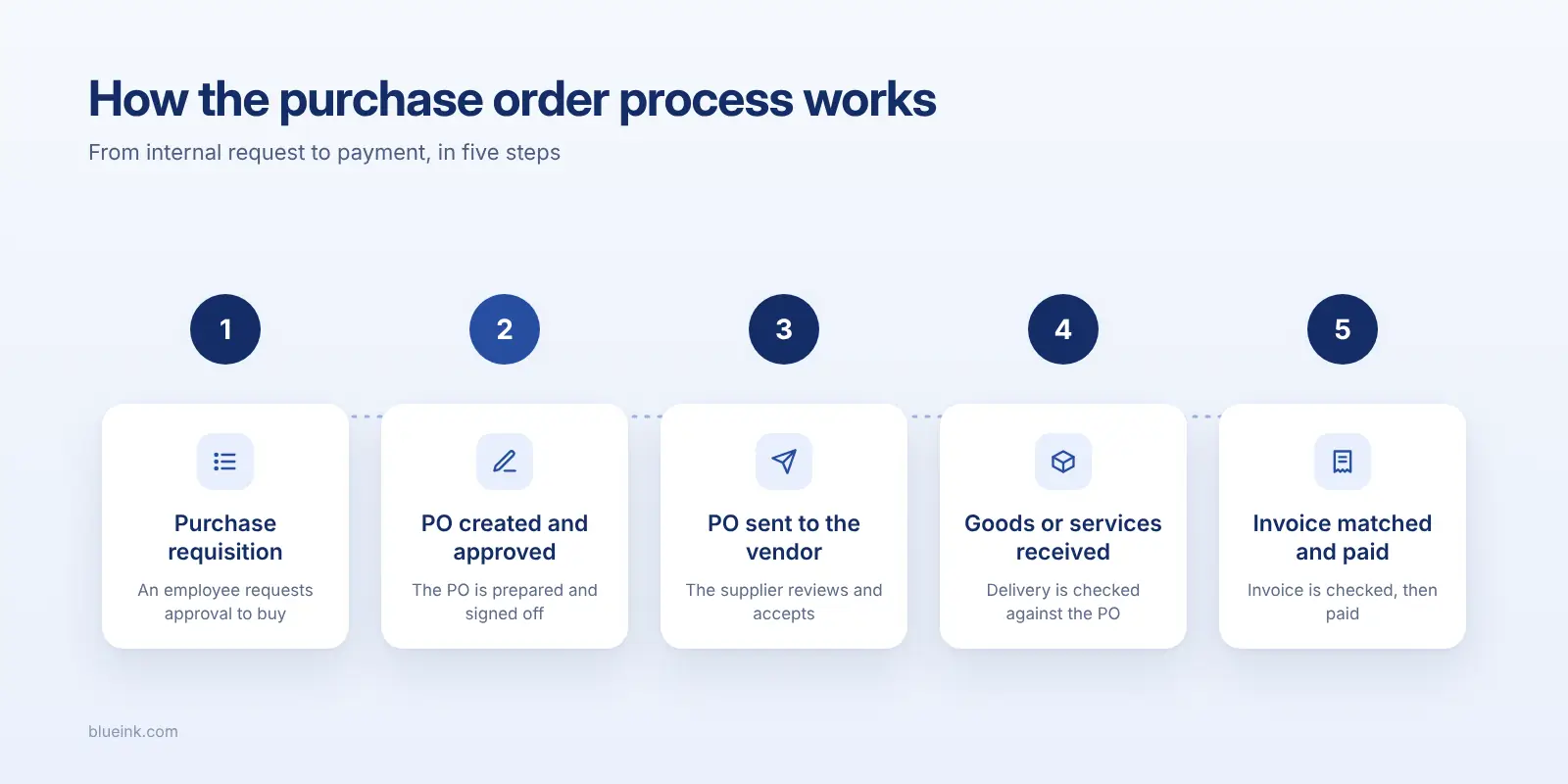
1. Purchase Requisition
The process often starts when an employee or department identifies a need for goods or services.
A purchase requisition is an internal request for authorization to make a purchase. It may describe what is needed, why it is required, the estimated cost, and the proposed supplier.
For example, an operations manager might request new office equipment for employees. The requisition is reviewed according to the organization's purchasing and budget approval procedures.
A purchase requisition is not the same as a purchase order. The requisition seeks internal approval, while the PO is the document issued to the supplier.
2. PO Created and Approved
After the purchase request is approved, the purchasing team or authorized employee prepares the purchase order. The PO includes the order details, supplier information, prices, and delivery requirements.
Before sending it, the organization may require approval from a department manager, finance representative, or another authorized person. This step confirms that the purchase has been reviewed and authorized according to internal procedures.
3. PO Sent to the Vendor
Once approved, the purchase order is sent to the supplier. The supplier reviews the order and may acknowledge acceptance, confirm availability, or request clarification.
For example, a supplier might confirm the requested quantity and delivery schedule or notify the buyer that an item is unavailable.
A PO is not necessarily binding simply because it was created or sent. Its legal effect depends on the supplier's acceptance, the relevant terms, and applicable law. In some circumstances, acceptance may occur through performance rather than a separate signature.
4. Goods or Services Received
The supplier fulfills the order by delivering the goods or providing the agreed services. The buyer then checks whether the delivery matches the purchase order.
For physical goods, this may include checking quantities, condition, and specifications. The receiving team may prepare a receiving report or goods receipt documenting what arrived.
For services, the organization may instead confirm that the agreed work or milestone has been completed. Any missing items, damaged goods, or discrepancies should be addressed before the transaction proceeds.
5. Invoice Matched and Paid
The supplier typically issues an invoice requesting payment according to the agreed terms. The buyer's finance or accounts payable team checks the invoice against the purchase order and relevant receiving records.
This helps confirm that the amount being requested is consistent with what was ordered and received. Once the required checks and approvals are complete, the invoice can proceed to payment.
The purchase order remains an important reference throughout this process, even after delivery has been completed.
Types of Purchase Orders
Businesses may use different purchase order structures depending on how frequently they purchase goods or services and how much information is known in advance.
Four common types are:
- Standard Purchase Order: Used for a specific, usually one-time purchase with defined items, quantities, prices, and delivery requirements.
- Planned Purchase Order: Outlines an anticipated purchase where certain details, such as delivery timing, may be confirmed later.
- Blanket Purchase Order: Covers recurring purchases from a supplier over an agreed period, often subject to spending limits or other conditions.
- Contract Purchase Order: References a broader purchasing arrangement or contract that establishes terms for future orders.
For example, a business buying computers for a new office might use a standard PO, while one regularly purchasing office supplies could use a blanket PO.
The names and exact functions of these purchase order types can vary between organizations and purchasing systems. For a broader discussion of business agreements, see Blueink's guide to types of contracts.
Purchase Order vs. Invoice: What's the Difference?
The main difference between a purchase order and an invoice is who issues the document and when it is used. A purchase order is typically issued by the buyer before the purchase is fulfilled. An invoice is issued by the supplier to request payment.
| Consideration | Purchase Order (PO) | Invoice |
|---|---|---|
| Issued by | Buyer | Supplier or seller |
| Main purpose | Authorize and document a purchase | Request payment |
| Timing | Usually before delivery or service fulfillment | According to the agreed billing arrangement |
| Key information | Ordered items, quantities, agreed prices, delivery and payment terms | Charges, amount due, payment terms, and invoice reference |
| Used for | Purchasing approvals and order tracking | Billing and accounts payable |
| Reference number | PO number | Invoice number |
Where does a receipt fit?
A payment receipt confirms that a payment has been made. A goods receipt or receiving report, by contrast, documents delivery of the ordered items. These records serve different purposes from both the purchase order and the invoice.
For more information about invoice preparation, read Blueink's guide on how to fill out an invoice. Blueink also provides tools to sign invoices online when an invoice requires acknowledgment or approval.
What Is Three-Way Matching?
Three-way matching is an accounts payable control that compares three documents before approving an invoice for payment:
- Purchase Order: What the buyer authorized or ordered.
- Receiving Report: What the business actually received.
- Supplier Invoice: What the supplier is requesting payment for.
The goal is to check that relevant details, particularly quantities, prices, and items received, agree across the records.
Three-Way Matching Example
Suppose a company orders 20 office chairs at $150 each.
| Document | Information Recorded |
|---|---|
| Purchase Order | 20 chairs at $150 each, totaling $3,000 |
| Receiving Report | 20 chairs received |
| Supplier Invoice | 20 chairs billed at $150 each, totaling $3,000 |
In this example, the quantities and amounts agree, so the invoice may proceed through the remaining payment approval process. However, if the receiving report confirms only 18 chairs while the invoice requests payment for 20, the business may need to investigate the difference.
Three-way matching helps identify discrepancies before payment, but it does not guarantee that every transaction is accurate or legitimate. For service purchases, organizations may use a service completion or acceptance record rather than a physical goods receiving report.
How to Approve Purchase Orders Faster with eSignatures
Purchase orders sometimes require approval from several people before they can be issued to suppliers. When approvals depend on printed documents or separate email exchanges, it can be difficult to determine which person still needs to review or sign.
Blueink supports the approval and signature stage of this process through features such as:
- Reusable templates: Prepare standardized PO approval documents with consistent fields.
- Signing order: Route documents to approvers sequentially or in parallel.
- Reminder Emails: Follow up on outstanding signature requests. Available on Business Pro and higher plans.
- Real-time tracking: Monitor document and signer status through Blueink's dashboard.
- Audit trail: Maintain a record of signing activity for completed documents.
- Bulk Send: Distribute documents to multiple recipients when needed. Available on Enterprise plans.
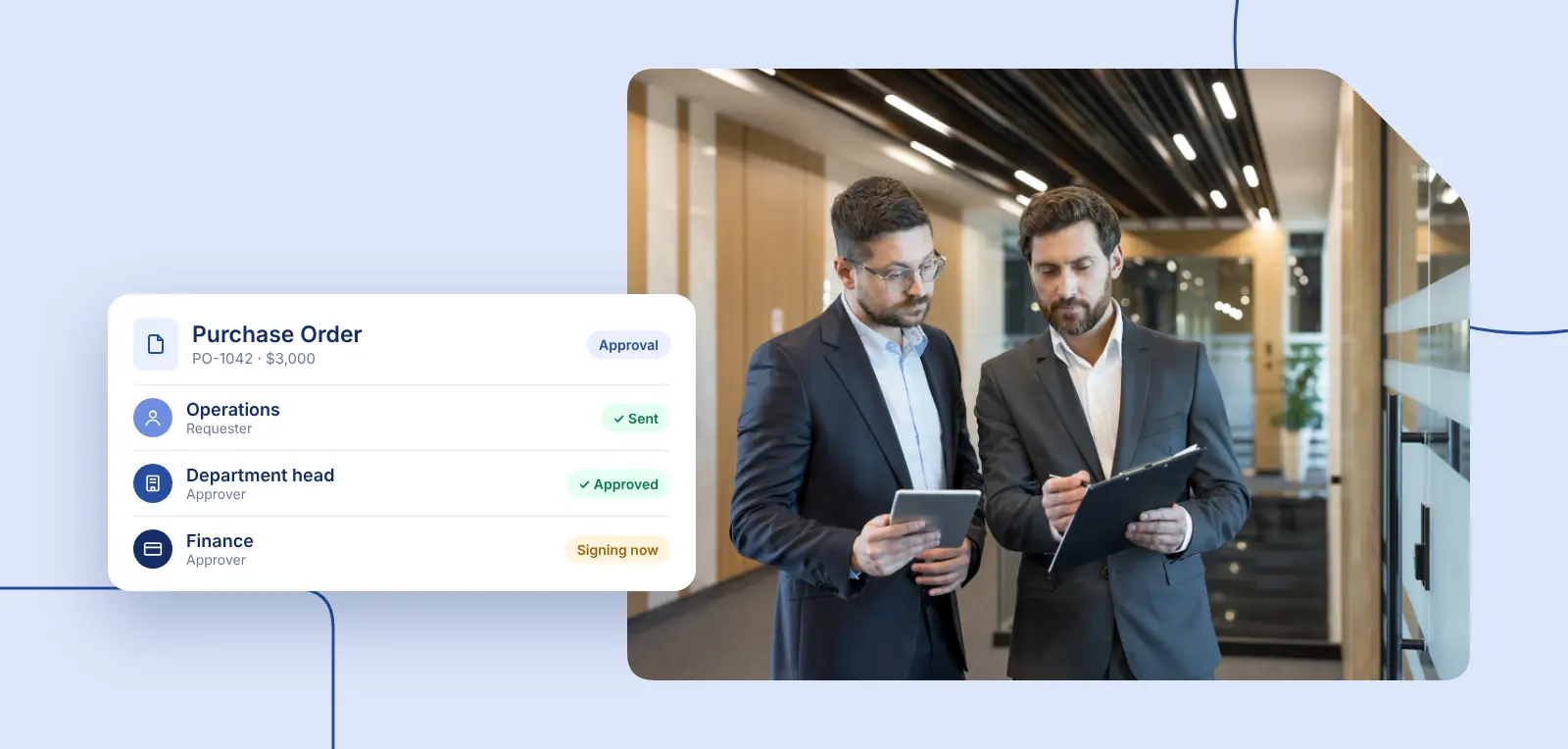
For example, an operations manager may prepare a PO approval document that requires a department head's approval before finance signs. Blueink can help route the document to the appropriate signers and track completion.
Blueink does not replace purchasing software, accounts payable systems, or processes such as inventory management and three-way matching. Its role is to help teams obtain and document the signatures required for an approved purchase.
For more info, explore eSignatures for procurement workflows and eSignature for procurement teams.
Simplify Purchase Order Approvals with Blueink
Purchase orders help businesses maintain clear records of what they intend to buy, what suppliers agree to provide, and how purchases are authorized.
When a PO requires signatures, Blueink can help teams prepare approval documents, route them to the appropriate people, and monitor completion without relying on printed paperwork.
Ready to simplify document approvals? Start your free trial with Blueink.
You can also explore how Blueink supports eSignature for procurement teams to help keep purchasing approvals moving.
Disclaimer: This article is for general informational purposes only and does not constitute legal or accounting advice.
Frequently Asked Questions
What Is a Purchase Order?
A purchase order is a document issued by a buyer to a supplier specifying the goods or services being purchased, along with quantities, prices, and other agreed terms. Businesses use purchase orders to authorize spending, communicate purchasing requirements, and maintain records for tracking deliveries and invoices.
Who Issues a Purchase Order?
The buyer issues the purchase order. Depending on the organization, it may be prepared by a purchasing department, operations team, finance team, or another authorized employee.
The supplier receives the PO and reviews the order before accepting or fulfilling it.
What Is the Difference Between a Purchase Order and an Invoice?
A purchase order is typically issued by the buyer before goods or services are delivered. It documents what the business intends to purchase and the agreed terms. An invoice is issued by the supplier to request payment for the goods or services provided, according to the billing arrangement.
Both documents may reference the same transaction, but they serve different purposes.
Is a Purchase Order a Legally Binding Contract?
A purchase order can become a legally binding contract when the supplier accepts its terms and the applicable requirements for contract formation are satisfied. Acceptance may occur through a written acknowledgment, signature, or conduct such as beginning performance, depending on the circumstances and governing law.
The terms of the PO, any existing agreement between the parties, and applicable law determine its legal effect.
What Is Three-Way Matching?
Three-way matching is the process of comparing a purchase order, receiving report, and supplier invoice. The purpose is to check whether the goods or services ordered, the quantity received, and the amount billed are consistent.
If discrepancies appear, the organization can investigate them before authorizing payment.
Can Purchase Orders Be Signed Electronically?
Yes. Purchase orders can generally be signed electronically when applicable legal requirements are met. Electronic signatures can be used to document internal approvals or supplier acceptance, depending on the transaction.
Under the federal ESIGN Act, covered electronic signatures and records generally cannot be denied legal effect solely because they are electronic. However, electronic signing does not automatically make every purchase order enforceable. The terms, authority of the signers, and applicable legal requirements still matter.
Disclaimer
Blueink is not a law firm and does not provide legal advice. This page is for informational purposes only and should not be considered a substitute for professional legal counsel. If you have questions about the validity or enforceability of eSignatures or digital signatures, we recommend consulting with a licensed attorney. Use of Blueink’s services is subject to our Terms of Use and Privacy Policy.

Weekly Newsletter
Get the latest updates, tips, and exclusive offers. Sign up for our weekly newsletter and stay informed!
Recent post
A purchase order (PO) is a document a buyer sends to a supplier to request goods or services at agreed prices and terms. Businesses use purchase orders to authorize purchases, track spending, and maintain a record of what was ordered. A PO helps both parties confirm the details before the supplier fulfills the order.
What Is a Purchase Order (PO)?
A purchase order is a formal document issued by a buyer to a supplier that specifies the goods or services being ordered, quantities, prices, delivery requirements, and payment terms. It is usually created after a business identifies a purchasing need and obtains the necessary internal approvals.
For example, a small business ordering 20 office chairs might issue a PO identifying the supplier, chair specifications, quantity, agreed price, and delivery date.
The supplier can use the document to confirm the order and prepare delivery, while the buyer can refer to it when checking that the goods and charges match what was agreed. A purchase order can also become a legally binding agreement when the supplier accepts it, depending on the terms, circumstances, and applicable law.
Why Businesses Use Purchase Orders
Purchase orders provide a consistent way to authorize and document business purchases.
They can help organizations:
- Control spending: Require appropriate approval before purchases are made.
- Clarify expectations: Document the agreed products, quantities, pricing, and delivery terms.
- Track purchases: Assign reference numbers that make orders easier to identify.
- Reduce discrepancies: Provide a record for checking deliveries and invoices.
- Improve accountability: Show who requested and approved a purchase.
- Maintain records: Support purchasing, accounting, and internal review activities.
Even small businesses can benefit from using POs when purchases involve multiple suppliers, employees, or approval requirements.
What Does a Purchase Order Include?
A purchase order should contain enough information for the supplier to understand the order and for the buyer to verify it later.
Common elements include:
- PO number: A unique reference used to identify and track the purchase.
- Issue date: The date the purchase order was created.
- Buyer information: Business name, address, and relevant contact details.
- Supplier information: Vendor name, address, and contact information.
- Description of goods or services: Clear identification of what is being purchased.
- Quantity: The number of items or units ordered, where applicable.
- Unit price: The agreed price for each item or service.
- Total amount: The total cost of the order, including applicable charges.
- Delivery details: Expected delivery date, location, and shipping instructions.
- Payment terms: Agreed payment deadlines and conditions.
- Approval information: Authorized approver or signature, if required.
- Additional terms: Relevant conditions, references, or instructions.
Example:
A purchase order for office equipment might include:
| Field | Example |
|---|---|
| PO Number | PO-2026-015 |
| Buyer | ABC Consulting LLC |
| Supplier | XYZ Office Supplies |
| Item | Ergonomic Office Chair |
| Quantity | 10 |
| Unit Price | $150 |
| Total | $1,500 |
| Delivery Date | December 10, 2026 |
| Delivery Location | ABC Consulting Office |
| Payment Terms | Net 30, subject to agreement |
The information should match the agreed purchasing terms. Missing quantities, unclear descriptions, or incorrect pricing can cause confusion when the supplier processes the order.
How the Purchase Order Process Works
The purchase order process typically begins with an internal request and ends when the goods or services have been received, the invoice has been checked, and payment has been completed. The exact steps may vary depending on the size of the business and its purchasing policies.

1. Purchase Requisition
The process often starts when an employee or department identifies a need for goods or services.
A purchase requisition is an internal request for authorization to make a purchase. It may describe what is needed, why it is required, the estimated cost, and the proposed supplier.
For example, an operations manager might request new office equipment for employees. The requisition is reviewed according to the organization's purchasing and budget approval procedures.
A purchase requisition is not the same as a purchase order. The requisition seeks internal approval, while the PO is the document issued to the supplier.
2. PO Created and Approved
After the purchase request is approved, the purchasing team or authorized employee prepares the purchase order. The PO includes the order details, supplier information, prices, and delivery requirements.
Before sending it, the organization may require approval from a department manager, finance representative, or another authorized person. This step confirms that the purchase has been reviewed and authorized according to internal procedures.
3. PO Sent to the Vendor
Once approved, the purchase order is sent to the supplier. The supplier reviews the order and may acknowledge acceptance, confirm availability, or request clarification.
For example, a supplier might confirm the requested quantity and delivery schedule or notify the buyer that an item is unavailable.
A PO is not necessarily binding simply because it was created or sent. Its legal effect depends on the supplier's acceptance, the relevant terms, and applicable law. In some circumstances, acceptance may occur through performance rather than a separate signature.
4. Goods or Services Received
The supplier fulfills the order by delivering the goods or providing the agreed services. The buyer then checks whether the delivery matches the purchase order.
For physical goods, this may include checking quantities, condition, and specifications. The receiving team may prepare a receiving report or goods receipt documenting what arrived.
For services, the organization may instead confirm that the agreed work or milestone has been completed. Any missing items, damaged goods, or discrepancies should be addressed before the transaction proceeds.
5. Invoice Matched and Paid
The supplier typically issues an invoice requesting payment according to the agreed terms. The buyer's finance or accounts payable team checks the invoice against the purchase order and relevant receiving records.
This helps confirm that the amount being requested is consistent with what was ordered and received. Once the required checks and approvals are complete, the invoice can proceed to payment.
The purchase order remains an important reference throughout this process, even after delivery has been completed.
Types of Purchase Orders
Businesses may use different purchase order structures depending on how frequently they purchase goods or services and how much information is known in advance.
Four common types are:
- Standard Purchase Order: Used for a specific, usually one-time purchase with defined items, quantities, prices, and delivery requirements.
- Planned Purchase Order: Outlines an anticipated purchase where certain details, such as delivery timing, may be confirmed later.
- Blanket Purchase Order: Covers recurring purchases from a supplier over an agreed period, often subject to spending limits or other conditions.
- Contract Purchase Order: References a broader purchasing arrangement or contract that establishes terms for future orders.
For example, a business buying computers for a new office might use a standard PO, while one regularly purchasing office supplies could use a blanket PO.
The names and exact functions of these purchase order types can vary between organizations and purchasing systems. For a broader discussion of business agreements, see Blueink's guide to types of contracts.
Purchase Order vs. Invoice: What's the Difference?
The main difference between a purchase order and an invoice is who issues the document and when it is used. A purchase order is typically issued by the buyer before the purchase is fulfilled. An invoice is issued by the supplier to request payment.
| Consideration | Purchase Order (PO) | Invoice |
|---|---|---|
| Issued by | Buyer | Supplier or seller |
| Main purpose | Authorize and document a purchase | Request payment |
| Timing | Usually before delivery or service fulfillment | According to the agreed billing arrangement |
| Key information | Ordered items, quantities, agreed prices, delivery and payment terms | Charges, amount due, payment terms, and invoice reference |
| Used for | Purchasing approvals and order tracking | Billing and accounts payable |
| Reference number | PO number | Invoice number |
Where does a receipt fit?
A payment receipt confirms that a payment has been made. A goods receipt or receiving report, by contrast, documents delivery of the ordered items. These records serve different purposes from both the purchase order and the invoice.
For more information about invoice preparation, read Blueink's guide on how to fill out an invoice. Blueink also provides tools to sign invoices online when an invoice requires acknowledgment or approval.
What Is Three-Way Matching?
Three-way matching is an accounts payable control that compares three documents before approving an invoice for payment:
- Purchase Order: What the buyer authorized or ordered.
- Receiving Report: What the business actually received.
- Supplier Invoice: What the supplier is requesting payment for.
The goal is to check that relevant details, particularly quantities, prices, and items received, agree across the records.
Three-Way Matching Example
Suppose a company orders 20 office chairs at $150 each.
| Document | Information Recorded |
|---|---|
| Purchase Order | 20 chairs at $150 each, totaling $3,000 |
| Receiving Report | 20 chairs received |
| Supplier Invoice | 20 chairs billed at $150 each, totaling $3,000 |
In this example, the quantities and amounts agree, so the invoice may proceed through the remaining payment approval process. However, if the receiving report confirms only 18 chairs while the invoice requests payment for 20, the business may need to investigate the difference.
Three-way matching helps identify discrepancies before payment, but it does not guarantee that every transaction is accurate or legitimate. For service purchases, organizations may use a service completion or acceptance record rather than a physical goods receiving report.
How to Approve Purchase Orders Faster with eSignatures
Purchase orders sometimes require approval from several people before they can be issued to suppliers. When approvals depend on printed documents or separate email exchanges, it can be difficult to determine which person still needs to review or sign.
Blueink supports the approval and signature stage of this process through features such as:
- Reusable templates: Prepare standardized PO approval documents with consistent fields.
- Signing order: Route documents to approvers sequentially or in parallel.
- Reminder Emails: Follow up on outstanding signature requests. Available on Business Pro and higher plans.
- Real-time tracking: Monitor document and signer status through Blueink's dashboard.
- Audit trail: Maintain a record of signing activity for completed documents.
- Bulk Send: Distribute documents to multiple recipients when needed. Available on Enterprise plans.
For example, an operations manager may prepare a PO approval document that requires a department head's approval before finance signs. Blueink can help route the document to the appropriate signers and track completion.
Blueink does not replace purchasing software, accounts payable systems, or processes such as inventory management and three-way matching. Its role is to help teams obtain and document the signatures required for an approved purchase.
For more info, explore eSignatures for procurement workflows and eSignature for procurement teams.
Simplify Purchase Order Approvals with Blueink
Purchase orders help businesses maintain clear records of what they intend to buy, what suppliers agree to provide, and how purchases are authorized.
When a PO requires signatures, Blueink can help teams prepare approval documents, route them to the appropriate people, and monitor completion without relying on printed paperwork.
Ready to simplify document approvals? Start your free trial with Blueink.
You can also explore how Blueink supports eSignature for procurement teams to help keep purchasing approvals moving.
Disclaimer: This article is for general informational purposes only and does not constitute legal or accounting advice.
Frequently Asked Questions
What Is a Purchase Order?
A purchase order is a document issued by a buyer to a supplier specifying the goods or services being purchased, along with quantities, prices, and other agreed terms. Businesses use purchase orders to authorize spending, communicate purchasing requirements, and maintain records for tracking deliveries and invoices.
Who Issues a Purchase Order?
The buyer issues the purchase order. Depending on the organization, it may be prepared by a purchasing department, operations team, finance team, or another authorized employee.
The supplier receives the PO and reviews the order before accepting or fulfilling it.
What Is the Difference Between a Purchase Order and an Invoice?
A purchase order is typically issued by the buyer before goods or services are delivered. It documents what the business intends to purchase and the agreed terms. An invoice is issued by the supplier to request payment for the goods or services provided, according to the billing arrangement.
Both documents may reference the same transaction, but they serve different purposes.
Is a Purchase Order a Legally Binding Contract?
A purchase order can become a legally binding contract when the supplier accepts its terms and the applicable requirements for contract formation are satisfied. Acceptance may occur through a written acknowledgment, signature, or conduct such as beginning performance, depending on the circumstances and governing law.
The terms of the PO, any existing agreement between the parties, and applicable law determine its legal effect.
What Is Three-Way Matching?
Three-way matching is the process of comparing a purchase order, receiving report, and supplier invoice. The purpose is to check whether the goods or services ordered, the quantity received, and the amount billed are consistent.
If discrepancies appear, the organization can investigate them before authorizing payment.
Can Purchase Orders Be Signed Electronically?
Yes. Purchase orders can generally be signed electronically when applicable legal requirements are met. Electronic signatures can be used to document internal approvals or supplier acceptance, depending on the transaction.
Under the federal ESIGN Act, covered electronic signatures and records generally cannot be denied legal effect solely because they are electronic. However, electronic signing does not automatically make every purchase order enforceable. The terms, authority of the signers, and applicable legal requirements still matter.