
Blueink vs Adobe Acrobat Sign: Which e-signature software is better?

Most organizations evaluating eSignature platforms start by comparing features. They look at whether a solution can send documents, collect signatures, integrate with existing tools, and maintain compliance. But in practice, that is rarely where the decision is won or lost.
At the enterprise level, most platforms have reached feature parity on the basics. The real differentiator is how efficiently those features are delivered at scale. This includes how pricing behaves as document volume grows, how workflows adapt to real business processes, and how much operational friction the platform introduces over time.
This is where the comparison between Blueink and Adobe Acrobat Sign becomes meaningful.
Adobe Acrobat Sign benefits from brand familiarity and a well-established ecosystem. It is often the default choice, especially for organizations already using Adobe products. However, as teams grow and document volume increases, pricing structures and feature limitations can begin to surface.
Blueink approaches the problem from a different angle. Rather than optimizing for brand familiarity, it is designed around high-volume workflows, compliance-heavy environments, and cost predictability. The result is a platform that, in many cases, delivers similar capabilities while reducing long-term operational costs.
So the question is no longer simply which platform can handle your documents.
It becomes: Which platform can support your growth without increasing complexity or cost disproportionately?
Overview of Blueink
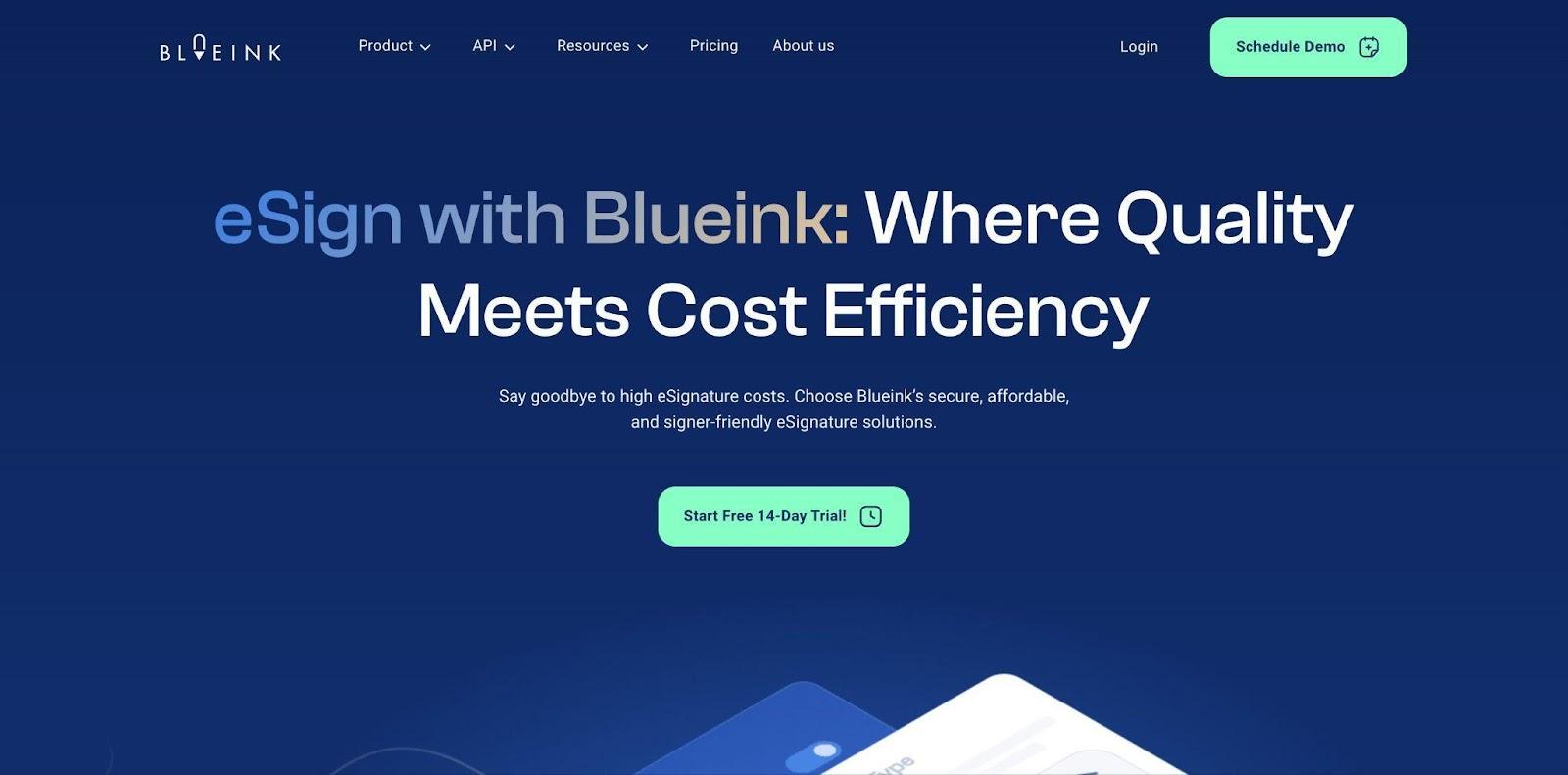
Blueink was built with a specific type of organization in mind: one that cannot afford mistakes in documentation, compliance, or auditability. This includes sectors such as healthcare, insurance, financial services, and HR-driven enterprises where every signature carries legal or regulatory weight.
Blueink focuses on structured workflows and verifiable signing processes. This is reflected in features like identity verification, audit trails, and Certificates of Evidence, which are not simply add-ons but core components of the platform.
What makes Blueink particularly relevant for growing organizations is how it approaches scalability.
Rather than tying cost directly to the number of users or forcing upgrades for essential functionality, Blueink includes key capabilities, such as templates, branding, reporting, and integrations, within its standard and enterprise offerings. This allows organizations to expand usage without constantly re-evaluating pricing tiers or feature access.
At the enterprise level, Blueink’s pricing model is based on transaction volume rather than user count, with per-envelope costs decreasing as usage increases. For example, pricing can drop to approximately $2.15 per envelope at higher volumes, with additional discounts applied for longer-term agreements .
This structure is not just about affordability. It is about predictability. Organizations can forecast costs more accurately, avoid overpaying for unused capacity, and align their spending with actual business activity.
Overview of Adobe Acrobat Sign
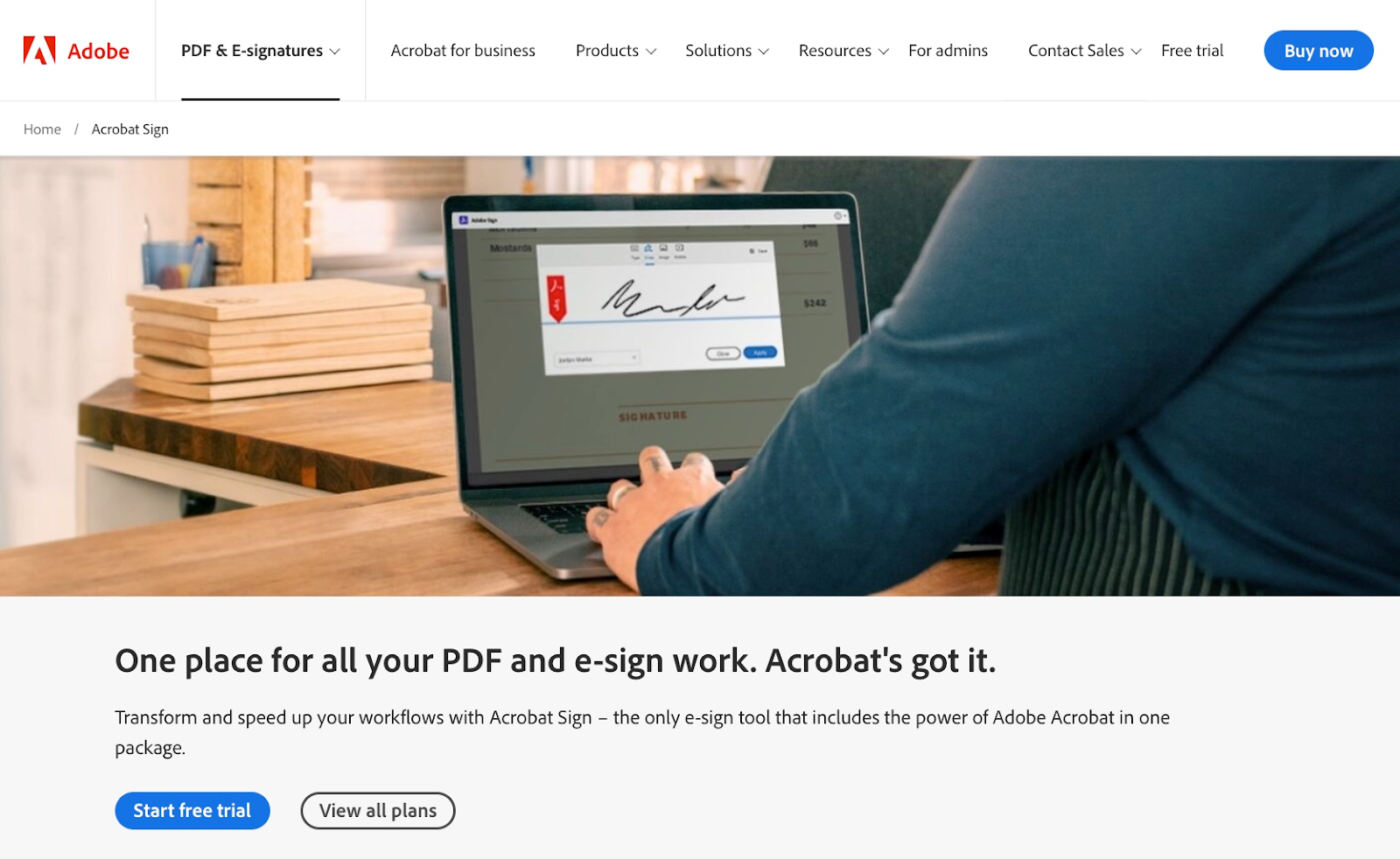
Adobe Acrobat Sign is part of a much broader ecosystem that includes document creation, editing, and collaboration tools. For organizations already embedded in Adobe’s environment, this integration can be a significant advantage.
The platform itself is mature, widely adopted, and designed to be accessible. Sending and signing documents is straightforward, and the interface is familiar to many users. Adobe also supports a wide range of integrations, particularly with Microsoft products, which makes it appealing for enterprise IT environments.
From a usability standpoint, Adobe Acrobat Sign performs well. Signers can complete documents without creating accounts, and the process is generally intuitive.
However, its pricing model reflects its broader positioning as part of a software suite.
Plans are typically structured around per-user subscriptions, starting at lower monthly price points for individuals and scaling up for teams and enterprise deployments. While this works well for smaller teams, it can become less efficient as organizations expand. Adding users increases costs directly, and higher-tier functionality may require plan upgrades or custom enterprise agreements.
In addition, while Adobe Acrobat Sign offers strong baseline security and compliance, some organizations find that configuring workflows to meet industry-specific requirements requires additional setup or reliance on higher-tier configurations.
Where the Comparison Becomes Meaningful
At a high level, both platforms can handle the core requirements of eSignature workflows. Documents can be sent, signed, tracked, and stored securely.
The difference begins to emerge in three key areas:
- First, how pricing behaves as usage increases.
- Second, how workflows adapt to real-world operational needs.
- Third, how much control organizations have over cost, compliance, and scalability.
Adobe Acrobat Sign tends to work well when usage is moderate and predictable, and when organizations benefit from its broader ecosystem.
Blueink becomes more compelling when:
- Document volume is high or growing
- Compliance requirements are strict
- Cost control is a priority over multi-year horizons
This is why many organizations do not initially question their choice of platform, but revisit it once costs begin to scale or inefficiencies become more visible.
Pricing Deep Dive: What Organizations Actually Pay Over Time
Pricing for eSignature platforms is often presented as a simple monthly fee per user. Adobe Acrobat Sign, for example, starts at around $12.99 to $29.99 per user per month depending on the plan. This structure works well for individuals or small teams.
However, as organizations scale, Adobe Acrobat Sign’s per-user pricing model becomes a key driver of cost. Each additional employee who needs to send or manage documents typically requires a paid license. Over time, this creates a direct link between headcount and total spend.
Blueink takes a different approach. Instead of scaling pricing based on users, Blueink pricing is tied primarily to document volume, particularly at the enterprise level. This allows organizations to expand access across departments without increasing licensing costs for every new user.
Depending on structure and usage, organizations commonly see 20 to 30% savings when switching from Adobe Acrobat Sign to Blueink. At higher volumes, Blueink’s pricing can reach approximately $2.15 per envelope, with additional discounts available for multi-year agreements.
This distinction is important because it changes how organizations control cost. With Adobe Acrobat Sign, growth in users typically increases cost. With Blueink, growth in usage can actually improve cost efficiency.
The Cost Drivers That Matter Most
When comparing Adobe Acrobat Sign and Blueink, the most meaningful differences are not always visible in base pricing.
With Adobe Acrobat Sign plans, cost is influenced by:
- Number of licensed users
- Plan tier required for features
- Document usage limits or thresholds
With Blueink plans, cost is influenced by:
- Total document volume
- Contract length
- Volume-based pricing tiers
This creates two very different outcomes.
With Adobe Acrobat Sign, organizations often need to forecast how many users will need access and choose plans accordingly. If usage changes, they may either exceed their plan or pay for unused capacity.
With Blueink, organizations can scale users more freely, while cost remains tied to actual document activity. In addition, unused envelopes can roll over, which helps reduce waste and improves cost efficiency over time.
Why This Matters Beyond Pricing
The difference between Adobe Acrobat Sign and Blueink is not just about cost. It affects how teams operate. If access to the platform is tied to user licenses, organizations may limit who can send documents. This can create bottlenecks or slow down workflows.
With Blueink, broader access can be provided without increasing licensing costs, which allows teams to move faster and reduces friction across departments.
Adobe Acrobat Sign remains a strong option, especially for organizations already embedded in the Adobe ecosystem. But for those prioritizing cost efficiency, scalability, and flexibility, the pricing model becomes a key differentiator.
Compliance and Security: Built-In vs Configured
Both Adobe Acrobat Sign and Blueink provide strong security foundations. Encryption, audit trails, and secure document storage are standard across both platforms. The difference lies in how compliance is implemented.
Adobe Acrobat Sign offers a flexible framework that can be configured to meet different compliance requirements. This works well for organizations with internal IT resources that can tailor workflows as needed.
Blueink takes a more direct approach. Compliance features are built into the platform and available from the start. These include identity verification methods such as SMS authentication, ID verification, and selfie authentication, along with detailed audit trails and Certificates of Evidence.
This matters for organizations in industries such as healthcare, insurance, and finance, where compliance is not optional and documentation must stand up to scrutiny. Instead of building compliance workflows on top of the platform, Blueink integrates them into the core experience.
Scalability: License Growth vs Usage-Based Growth
Scalability is where the difference between Adobe Acrobat Sign and Blueink becomes more operational than technical. Adobe Acrobat Sign scales by adding users. As more people need access, more licenses are required. This model works well when usage is predictable and tied closely to specific roles.
However, in organizations where document workflows expand across departments, this can introduce friction. Teams may limit access to control cost, which can slow down processes.
Blueink scales differently. Because pricing is not tied to user count, organizations can extend access across teams without increasing licensing costs. Growth is driven by usage rather than headcount.
This creates a more flexible environment where:
- More employees can participate in workflows
- Processes can be decentralized
- Adoption is not constrained by licensing decisions
Over time, this leads to more efficient operations, especially in organizations with high document volume.
Customization and Workflow Control
Both platforms support document templates, routing, and workflow automation. The difference is how accessible and scalable these capabilities are.
Adobe Acrobat Sign offers customization, but more advanced workflows and automation often depend on plan level or configuration. For some organizations, this is not an issue. For others, it introduces additional steps when scaling processes.
Blueink includes:
- Unlimited templates
- SmartLink Forms for streamlined signing experiences
- Advanced fields and workflow customization
- Bulk sending capabilities
Because these features are included rather than tiered, organizations can build and refine workflows without needing to revisit their pricing structure.
This is particularly valuable in environments where processes evolve frequently or where multiple departments require different workflows.
Integrations and Ecosystem Fit
Adobe Acrobat Sign has a strong advantage when it comes to integrations, particularly within the Adobe and Microsoft ecosystems. For organizations already using tools like Acrobat, Microsoft 365, or SharePoint, this creates a seamless experience.
Blueink also offers integrations and API access, allowing it to connect with existing systems and support custom workflows. While it may not have the same breadth of pre-built integrations as Adobe, it provides the flexibility needed for most enterprise environments.
The choice here depends largely on existing infrastructure. If an organization is deeply embedded in Adobe tools, Adobe Acrobat Sign offers convenience. If flexibility and customization are priorities, Blueink provides a more adaptable foundation.
Customer Support and Implementation
Support is often overlooked during evaluation, but it becomes critical during implementation and scaling. Adobe Acrobat Sign typically offers tiered support, with more advanced support options available at higher pricing levels or through enterprise agreements.
Blueink includes support as part of its offering. This includes onboarding, training, and access to a customer success team. For organizations that need guidance during implementation or want to optimize workflows over time, this can make a meaningful difference.
Instead of treating support as an add-on, Blueink positions it as part of the platform experience.
The Bottom Line
Adobe Acrobat Sign delivers reliability, familiarity, and ecosystem integration. Blueink delivers control, efficiency, and scalability. For organizations with lower document volume or strong reliance on Adobe tools, Adobe Acrobat Sign remains a logical choice.
For organizations managing high volumes of documents, operating in regulated industries, or looking to reduce costs by 20% to 30% without sacrificing capability, Blueink offers a more aligned solution.
The decision is not about which platform is better in general. It is about which platform is better aligned with how your organization operates and how it plans to grow.
Next Steps
If your organization is evaluating eSignature platforms, the most effective next step is a direct comparison based on your actual usage.
Look at:
- Number of documents processed annually
- Number of users who need access
- Compliance requirements
- Long-term cost projections
When these factors are evaluated side by side, the differences between Adobe Acrobat Sign and Blueink become much clearer.
For many organizations, the conclusion is not immediate. But once usage scales and costs are examined over time, the direction tends to become obvious.
Want to discover if Blueink is a good fit for your needs? Schedule a demo with us today.
Disclaimer
Blueink is not a law firm and does not provide legal advice. This page is for informational purposes only and should not be considered a substitute for professional legal counsel. If you have questions about the validity or enforceability of eSignatures or digital signatures, we recommend consulting with a licensed attorney. Use of Blueink’s services is subject to our Terms of Use and Privacy Policy.

Recent post
October 12, 2026
October 6, 2026
October 1, 2026
September 22, 2026
September 15, 2026