

eSignature Pricing Transparency: Why Teams Leave DocuSign and PandaDoc

For many teams, choosing an eSignature platform starts simple.
You compare a few tools. You pick a well-known name like DocuSign or PandaDoc. You get started.
Then things change.
Costs become harder to predict. Features feel tied to higher plans. Workflows take longer than expected. And the tool that was supposed to simplify your process starts adding friction.
That’s when teams begin looking for alternatives.
Instead of asking DocuSign vs PandaDoc, more teams are asking a more practical question: Is there a simpler, more predictable way to get documents signed?
Why Pricing Frustration Is Driving Teams to Switch
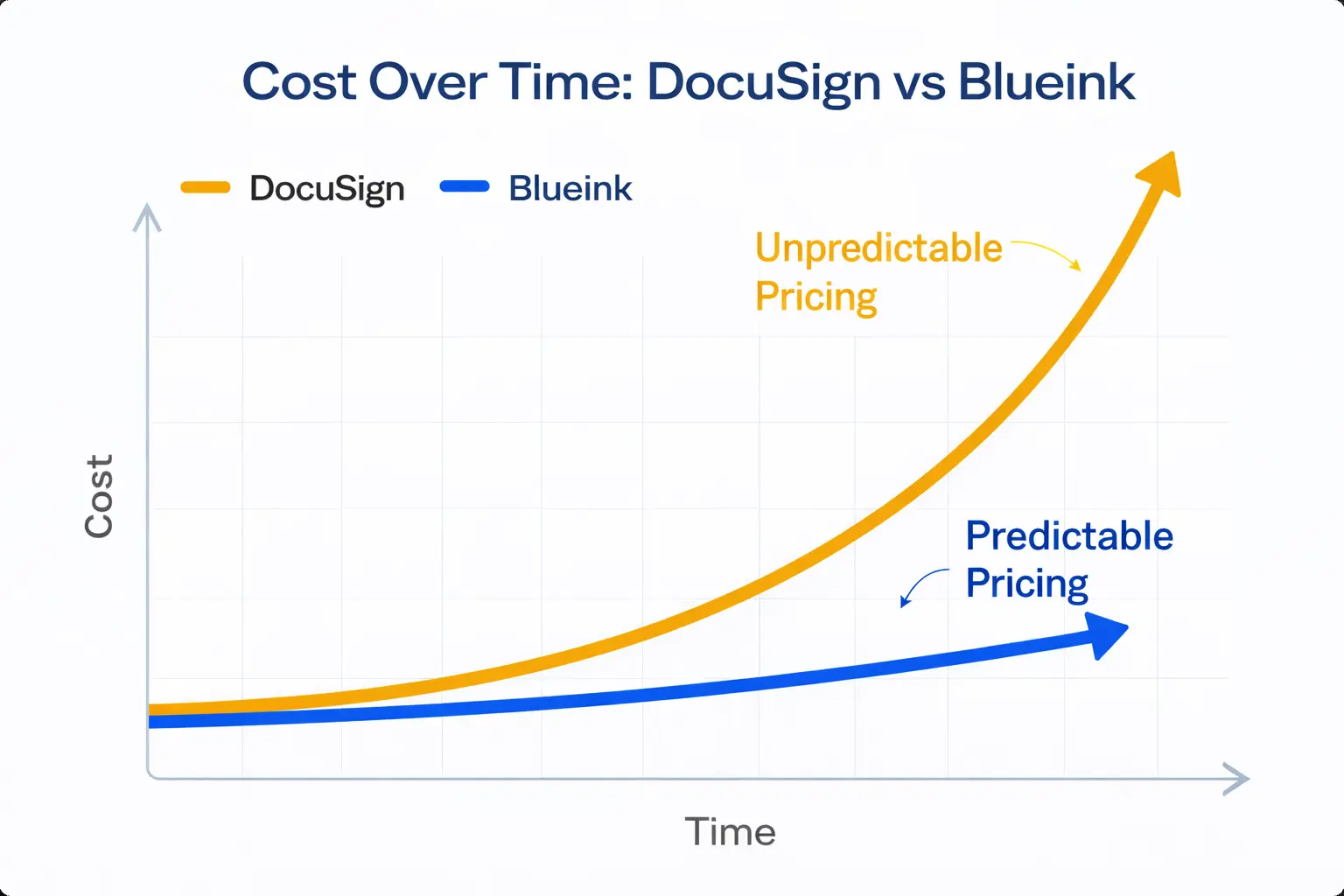
Most businesses do not switch platforms without a clear reason. In many cases, that reason comes down to pricing and how it evolves as the business grows.
1. Pricing That Becomes Hard to Predict
Pricing often appears straightforward at the start. However, as usage increases, the cost structure becomes less transparent.
Envelope limits are reached more quickly than expected, additional usage introduces incremental costs, and certain features are only available through higher-tier plans. What initially feels manageable can become difficult to forecast as document volume grows.
For teams that rely heavily on document workflows, this lack of predictability makes budgeting and scaling more complex than it should be.
2. Paying for Features You Don’t Fully Use
Another common challenge is paying for bundled functionality that does not fully align with how teams actually work.
Many platforms package advanced features into higher plans, even when those features are rarely used. Over time, teams find themselves navigating tools they do not need while still lacking flexibility in the areas that matter most.
Instead of simplifying workflows, the platform begins to feel like something that must be worked around.
3. Scaling Costs as Your Business Grows
Growth should lead to efficiency, not added friction. Yet with some platforms, increased usage brings higher per-envelope costs, more expensive subscription tiers, and additional charges tied to team expansion.
This creates a situation where operational success is directly tied to rising costs, making it harder to scale confidently.
The Hidden Cost of “Well-Known” Platforms
There is a reason DocuSign and PandaDoc are widely adopted. They are established, trusted, and familiar. However, familiarity does not always translate into efficiency.
Over time, teams often encounter small inefficiencies that accumulate. Workflows still require manual steps, document turnaround times remain longer than expected, and flexibility is limited without upgrading plans. Even support can vary depending on subscription level.
Individually, these issues may seem minor. Collectively, they impact productivity, slow down execution, and create unnecessary delays across the organization.
Why Teams Are Looking Beyond DocuSign vs PandaDoc
Most comparisons focus on which platform offers more features or better pricing tiers. But for many teams, that framing misses the point.
What they actually need is much simpler:
- Clear, predictable pricing
- Workflows that are easy to set up and repeat
- Reliable support when issues arise
- Flexibility without constant plan changes
As a result, more teams are looking beyond traditional comparisons and considering alternatives that prioritize usability and efficiency.
What Makes Blueink Different
Blueink is built around the idea that document signing should be straightforward.
Rather than layering features and pricing tiers, it focuses on making workflows easier to execute, easier to manage, and easier to scale. The emphasis is not on adding complexity, but on removing it.
1. Transparent, Predictable Pricing
One of the most immediate differences teams notice is pricing clarity.
With Blueink, costs remain more consistent as usage increases. Unused envelopes can roll over, and support is included rather than restricted by plan level. This reduces the need for frequent upgrades or adjustments and allows teams to plan more confidently.
2. Built for Real Workflows
Blueink is designed around how documents actually move through an organization. Instead of forcing teams into rigid structures, it supports practical use cases such as:
- Sending documents via SMS to improve visibility and response time
- Allowing signers to begin immediately through SmartLinks
- Collecting signatures in person using mobile or tablet devices
- Sending documents in bulk without repetitive manual steps
These capabilities are not added complexity. They are intended to reduce friction at each stage of the process.
3. Faster Document Turnaround
Speed improves when barriers are removed.
By combining SMS delivery, simple signing flows, and mobile-friendly access, Blueink reduces the steps required to complete a document. Signers can access and sign immediately without navigating unnecessary obstacles.
The result is a more responsive process that supports faster completion times.
4. Flexibility Without Complexity
In many platforms, flexibility is tied to higher-tier plans. Blueink takes a different approach by allowing teams to adjust workflows, reuse templates, and standardize processes without restructuring their subscription.
This makes it easier to adapt as business needs change, without introducing additional layers of complexity.
5. Support That Is Built In
Support often becomes critical as usage increases.
Blueink includes accessible support as part of the experience, along with guidance for setup and workflow optimization. This helps teams resolve issues quickly and ensures that adoption does not stall due to lack of assistance.
Comparing the Experience
DocuSign and PandaDoc each have strengths, particularly in brand recognition and feature breadth. However, they are often optimized for enterprise-scale configurations or specific use cases like document creation and proposals.
Blueink takes a more focused approach. It is designed to simplify execution, reduce friction, and provide a more predictable experience for teams that prioritize speed and usability over feature complexity.
For the exact numbers side by side, see the detailed pricing and feature comparison.
Why Predictability Matters
In a growing business, unpredictability creates unnecessary risk.
When costs fluctuate or workflows require constant adjustment, teams spend more time managing the system than executing their work. Predictable pricing and consistent workflows allow organizations to focus on performance instead of administration.
This is one of the key reasons more teams are prioritizing simplicity and transparency when evaluating eSignature solutions.
What to Look for in an eSignature Platform
When evaluating options, focus on outcomes rather than features alone:
- Is pricing easy to understand and forecast?
- Can workflows be implemented quickly and consistently?
- Does the platform scale without frequent plan changes?
- Is support available when needed?
- Does it reduce manual work and improve turnaround time?
Fix the Process, Not the Platform Name
Many teams stay with familiar platforms longer than they should, simply because they are widely used.
However, document turnaround time, cost control, and workflow efficiency are not determined by brand recognition. They are determined by how well the platform fits your process.
Improving outcomes often requires rethinking the workflow, not just the tool.
Why Blueink Fits This Shift
Blueink aligns with what many teams are now prioritizing:
- Simplicity over feature overload
- Predictability over variable pricing
- Speed over unnecessary complexity
- Practical workflows that reflect real use cases
It is not about replacing one platform with another. It is about creating a more efficient way to manage document workflows.
Try a Simpler Approach
If pricing has become difficult to manage or workflows feel more complex than they should be, it may be time to reassess. Blueink offers a more straightforward approach to document signing, built around clarity, speed, and usability.
Start with a focused use case. Evaluate how it performs in your workflow. Then expand from there.
Ready to explore a simpler approach to eSigning? Schedule a demo today.
Disclaimer
Blueink is not a law firm and does not provide legal advice. This page is for informational purposes only and should not be considered a substitute for professional legal counsel. If you have questions about the validity or enforceability of eSignatures or digital signatures, we recommend consulting with a licensed attorney. Use of Blueink’s services is subject to our Terms of Use and Privacy Policy.

Recent post
October 12, 2026
October 6, 2026
October 1, 2026
September 22, 2026
September 15, 2026


